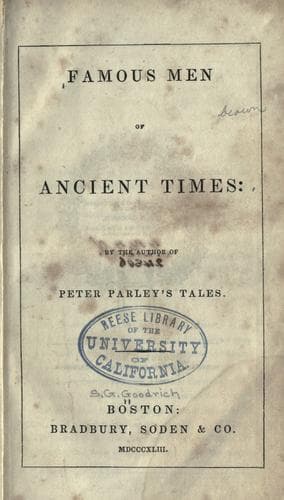
Famous Men of Ancient TimesGoodrich, Samuel G. (Samuel Griswold)
History
Famous Men of Ancient Times
Goodrich, Samuel G. (Samuel Griswold)
Biography -- Juvenile literature; Men -- Biography -- Juvenile literature
“_Seen and approved by the Russian commander of the town of Coblentz,
January 1, 1814._”
It is true that no such speedy retort awaited the Macedonian conqueror,
yet he was bound upon an errand which was ere long to put a period to
his proud career.
Alexander soon pushed on to the East, and, meeting Darius near the
Gulf of Issus, now Aias, and forming the north-eastern point of
the Mediterranean, a tremendous engagement took place. Darius was
defeated, and more than one hundred thousand of his soldiers lay
dead on the field. Darius escaped with difficulty, leaving his tent,
and even his wife and daughter, in the hands of the enemy. When the
fighting was over, Alexander went to see the tent of Darius. It
was, indeed, a curiosity to one like the Macedonian king, little
acquainted with eastern refinements. He gazed for a time at the
luxurious baths of Darius; his vases, boxes, vials and basins, all of
wrought gold; he inhaled the luscious perfumes, and surveyed the rich
silk drapery and gorgeous furniture of the tent—and then exclaimed,
contemptuously—“This, then, it seems, is to be a king,”—intimating
that if these were the only distinctions of a king, the title deserved
contempt.
While Alexander was thus occupied, he was told that the wife and
daughter of Darius were his captives. The queen was one of the
loveliest women that was ever known, and his daughter was also
exceedingly beautiful. Though Alexander was told all this, he sent word
to the afflicted ladies that they need have no fear; and he caused them
to be treated with the utmost delicacy and attention. He refrained from
using his power in any way to their annoyance; and thus displayed one
of the noblest graces of a gentleman and a man—a nice regard for the
feelings of the gentler sex. This anecdote of the conqueror has shed
more honor upon his name for two thousand years, than the victory of
the Issus; nor will it cease to be cited in his praise, as long as
history records his name.
Public-domain text, read in full here on John Shaqi.
Reviews
Reviews
No reviews yet
Be the first to share your thoughts on this work.
Elsewhere in the archive
Join the Discussion
Join the discussion
Sign in to leave a comment or review.
Sign InorCreate an account