On December 18, 1856, he issued the first number of the "Clinton
Herald," a weekly publication having as competitors two other
well-established newspapers at Lyons, only one mile north in the same
county. There was really no field at Clinton at that time for a
newspaper, but Leonard thought otherwise. The panic of 1857 caught the
enterprise in the weakness of infancy; but the paper survived the
financial storm and eventually came forth on the top wave of success,
all of which was undoubtedly due to the excellent business management of
Leonard and the strong personality he threw into his work. When the
general offices of the Chicago and Northwestern Railroad were removed to
Chicago in 1865, Mr. Leonard moved the fine job office connected with
the "Herald" to that city, as the nucleus for the extensive printing
establishment he later acquired.
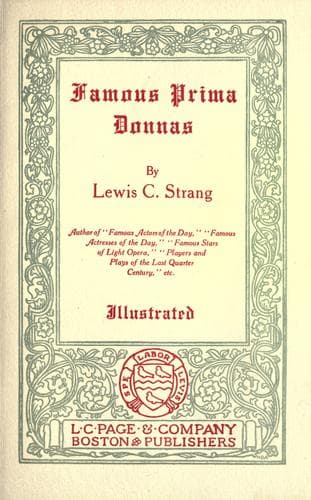
After the family moved to Chicago, Lillian Russell spent several years
in the Convent of the Sacred Heart in that city. Her first music lessons
were on the violin, and were given by Professor Nathan Dyer. Then she
took vocal lessons from Professor Gill in Chicago. When the time came
for him to show off his pupils, he gave a musicale in Chickering Hall.
The fair-haired Lillian sang at this concert "Let Me Dream again" by
Sullivan and "Connais-tu le Pays?" from "Mignon." The papers, of course,
gave her complimentary notices, one declaring that she sang "like an old
professional." Possibly it was this notice that first turned her mind
toward the stage. For some time after that, however, she sang in St.
John's Episcopal Church on the West Side, and studied with Madame
Jennivally, who encouraged her in her ambition to become a grand opera
singer. With the idea of studying for the grand opera stage, she went to
New York to have her voice tried, and she had taken but a few lessons of
the late Dr. Damrosch when Mrs. William E. Sinn persuaded her to join
the chorus of Edward E. Rice's "Pinafore" company for the sake of the
experience on the stage. This connection lasted about two months and was
terminated by her first matrimonial experience, her marriage to Harry
Braham, the musical director of the company. She retired from the stage
for a time, but her domestic happiness did not last long. It then became
a matter of necessity for her to get an engagement, and she applied in
vain to such managers as McCaull and D'Oley Carte, who could find
nothing in her voice to warrant them in giving her a chance.
Public-domain text, read in full here on John Shaqi.
Reviews
Reviews
No reviews yet
Be the first to share your thoughts on this work.
Join the Discussion
Join the discussion
Sign in to leave a comment or review.
Sign InorCreate an account