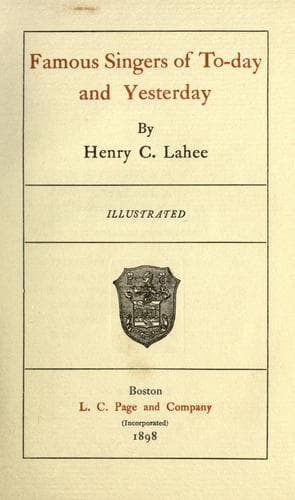
Famous Singers of To-day and Yesterday — John Shaqi
Famous Singers of To-day and YesterdayLahee, Henry Charles
History
Famous Singers of To-day and Yesterday
Lahee, Henry Charles
Singers
Staudigl's last appearance took place in 1856, on Palm Sunday, for a few
days later he became a victim to insanity, from which he never
recovered. He made repeated tours abroad, and was much admired wherever
he went. As a singer of Schubert's Lieder he was without a rival, and
his performances of the "Erlkoenig," the "Wanderer," and "Aufenthalt"
were considered wonderful. His death occurred in 1861, and his funeral
was the occasion of a great demonstration.
Manuel Garcia, the tenor, had two daughters who both achieved the
highest distinction on the operatic stage. The eldest, Maria Felicien,
became Madame Malibran, and she is mentioned to-day as one of the most
wonderful operatic singers that the world has produced. Daring
originality stamped her life as a woman and her career as an artist, and
the brightness with which her star shone through a brief and stormy
history had something akin in it to the dazzling but capricious passage
of a meteor.
As a child she was delicate, sensitive, and self-willed, and she had a
prodigious instinct for art. Nevertheless, her voice was peculiarly
intractable, being thin in the upper notes, veiled in the middle tones,
and her intonation very imperfect. On leaving school she was taken in
hand by her father, who was more pitiless to her than to his other
pupils. He understood her disposition thoroughly, and said that she
could never become great except at the price of much suffering, for her
proud and stubborn spirit required an iron hand to control it.
Soon after making her debut she went with her father to America, for he
had conceived a project for establishing opera in the United States. His
company consisted of himself, Madame Garcia, a son, and his daughter.
Maria's charming voice and personal fascination held the public
spellbound, and raised the delight of opera-goers to a wild pitch of
enthusiasm. While in New York, a French merchant, M. Francois Eugene
Malibran, fell passionately in love with her, and she, being sick of her
father's brutality, and the supposed great fortune of Malibran dazzling
her imagination, married him, though in opposition to her father's
will. A few weeks after the marriage M. Malibran was a bankrupt, and
imprisoned for debt, and his bride discovered that she had been cheated
by a cunning scoundrel, who had calculated on saving himself from
poverty by dependence on the stage earnings of his wife. Garcia and the
rest of his family went to Mexico, where he succeeded in losing his
fortune. Madame Malibran remained in New York with her husband; but at
the end of five months she wearied of her hard fate, and, leaving him,
returned to Paris. Here she soon had the world at her feet, for the
novelty and richness of her style of execution set her apart from all
other singers as a woman of splendid and inventive genius.
Public-domain text, read in full here on John Shaqi.
Reviews
Reviews
No reviews yet
Be the first to share your thoughts on this work.
Join the Discussion
Join the discussion
Sign in to leave a comment or review.
Sign InorCreate an account