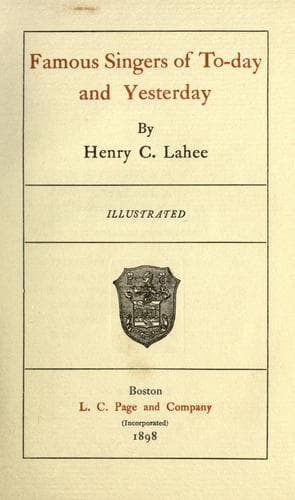
Famous Singers of To-day and YesterdayLahee, Henry Charles
History
Famous Singers of To-day and Yesterday
Lahee, Henry Charles
Singers
Mario, who followed Rubini as tenor in the celebrated "Puritani"
quartet, was more closely connected with the career of Madame Grisi than
any other singer, for he became her husband. His proper title was Mario,
Cavaliere di Candia; but, in order to soothe the family pride, he was
known on the stage by his Christian name only. When he first went to
Paris, in 1836, he held a commission in a Piedmontese regiment. The
fascinating young Italian officer was welcomed in the highest circles,
for his splendid physical beauty, and his art-talents as an amateur in
music, painting, and sculpture, separated him from all others, even in a
throng of brilliant and accomplished men. In Paris he fell into debt,
and, having a beautiful voice, he accepted the proposition of Duponchel,
the manager of the opera, and entered upon stage life. Though his
singing was very imperfect and amateurish, his princely beauty and
delicious, fresh voice took the musical public by storm.
Mario will live in the world's memory as the best opera-lover ever seen.
In such scenes as the fourth act of "Les Huguenots," and the last act of
"Favorita," Mario's singing and acting were never to be forgotten by
those that witnessed them. Intense passion and highly finished vocal
delicacy combined to make these pictures of melodious suffering
indelible. As a singer of romances he has never been equalled; in those
songs where music tells the story of passion, in broad, intelligible,
ardent phrases, and presents itself primarily as the vehicle of violent
emotion, Mario stood ahead of all others of his age. For a quarter of a
century he remained before the public of Paris, London, and St.
Petersburg, but he did not finally retire until 1867.
The story of Mario's life reads like a romance. At times he was steeped
in the depths of poverty; at others, he enjoyed great wealth and lived
in princely style. Shortly after his first arrival in Paris, he found
himself deeply in debt, and so poor that he was obliged to sleep in a
very cheap lodging-house where several people occupied one room. One
night he awoke and found a man kneeling over him, to rob him. "What do
you want?" asked Mario. "Your money," was the reply. "Take all you can
find, my friend," answered Mario, "but please let me continue my dreams
and my sleep."
Mario was as careless in regard to time as to money. It is related that
once upon a time he arrived half an hour early, to keep an appointment.
Nobody was more surprised than Mario himself, and, after investigation,
he discovered that he had mistaken eleven o'clock for five minutes to
twelve, and would have been the customary half hour late if his
calculations had been correct.
Public-domain text, read in full here on John Shaqi.
Reviews
Reviews
No reviews yet
Be the first to share your thoughts on this work.
Join the Discussion
Join the discussion
Sign in to leave a comment or review.
Sign InorCreate an account