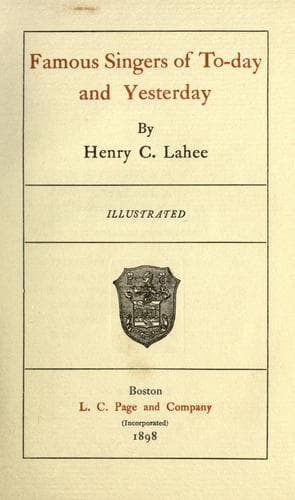
Famous Singers of To-day and YesterdayLahee, Henry Charles
History
Famous Singers of To-day and Yesterday
Lahee, Henry Charles
Singers
On leaving the Conservatory, she was invited to sing in concerts in
Philadelphia, Baltimore, Cleveland, St. Louis, and New York, where she
took leading parts in the oratorios of "Elijah," "Creation," "Messiah,"
etc. In 1873 she was engaged for a concert tour in England, Scotland,
Ireland, Belgium, Holland, and France, during which her repertoire
consisted of classical music only. During this tour she sang at the
Crystal Palace, near London, and at the Trocadero in Paris. She then
went to Milan, where she studied opera under Signor Sangiovanni, and
made her operatic debut at Brescia, in "Traviata."
In October, 1880, she was engaged at Genoa for fifteen performances of
"Faust," in which she took the part of Marguerite. She next sang at
Novara, where she took the part of Alice in "Roberto," and was
afterwards engaged for thirty-five performances at Aquila in "Faust,"
"Rigoletto," and "Lucia."
Her next engagement was in St. Petersburg, where she sang in
"L'Africaine," taking the role of Inez, in "The Marriage of Figaro" as
Cherubino, in "Mignon" as Filina, in "Ugonotti" as Queen Marguerite, in
"Don Giovanni" as Zerlina, and in "Il Propheto" as Berta, besides other
operas. Thus she acquired in a comparatively short time, and by dint of
extremely hard work, quite an extensive repertoire.
In 1882 she endured the crucial test of the Grand Opera House in Paris,
where, in spite of the "Claque," which is so frequently organized to
kill off new singers, she made a grand success, and an engagement for
three years ensued. Some years later, however, in spite of the renown
which she had gained, fickle Paris grew cold, and critics were laconic.
At this time Nordica did not need the approval of Paris, for she was
well established among the great singers of the period, and it is
recognized that, while a success in Paris is considered an important
conquest, a failure counts for little. The firm establishment of the
"Claque," which is so well described by Mr. Sutherland Edwards, and the
proverbial caprice of Parisian audiences, are sufficient to take the
edge off of defeat. At the termination of her engagement in Paris, in
1883, Nordica married Mr. Frederick A. Gower, who shortly afterwards was
supposed to have lost his life while attempting to cross the English
Channel in a balloon. This matter remained a mystery for many years,
for, while there was no doubt that he started on the perilous journey,
nothing was ever after seen or heard of him or of the balloon. The
question of his death, therefore, remained in doubt, and when, after a
lapse of more than a dozen years, it was announced that Madame Nordica
was about to enter the bonds of matrimony a second time, she suffered
much annoyance from the rumors which were spread about to the effect
that Mr. Gower was in various parts of the world. These rumors never
proved to have any foundation, and, except for the annoyance, must have
been somewhat flattering as evidence of the interest taken in the prima
Public-domain text, read in full here on John Shaqi.
Reviews
Reviews
No reviews yet
Be the first to share your thoughts on this work.
Elsewhere in the archive
Join the Discussion
Join the discussion
Sign in to leave a comment or review.
Sign InorCreate an account