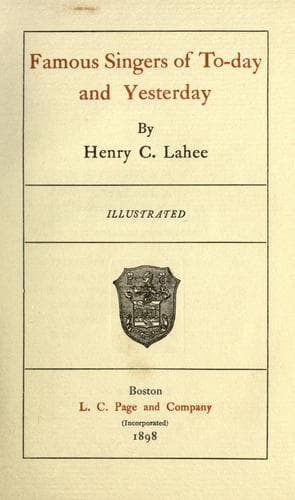
Famous Singers of To-day and YesterdayLahee, Henry Charles
History
Famous Singers of To-day and Yesterday
Lahee, Henry Charles
Singers
donna by the public.
In 1887 Nordica sang in Berlin, and made a complete capture of the
Berlinese, a most unusual achievement for an American prima donna. She
also appeared in London at Drury Lane, and by the sweetness and
freshness of her voice, and by the alternating charm and intensity of
her style as an actress, she won a firm and lasting hold on the British
public. She now enjoyed the most marked social attentions, and sang at a
state concert at Buckingham Palace before an audience composed of
princes, princesses, dukes, Indian royalties, etc. The Princess of Wales
came forward and thanked her, the prince added his word, and her triumph
was complete. The climax was reached, however, when she was commanded by
the queen to sing in Westminster Abbey. She sang "Let the bright
Seraphim," which selection has for years been the standard for state
occasions. Indeed, it may be said that when a prima donna has been
commanded to sing "Let the bright Seraphim," in Westminster Abbey, she
has achieved the highest honor possible in England. Madame Albani has
exceeded this in having had the honor of lunching with the queen, but
this latter was more a tribute to her worth as a woman than as an
artist.
One of Nordica's greatest assumptions has been that of the role of Elsa
in "Lohengrin." She has the feeling, the artistic understanding, which,
combined with beautiful vocal gifts, brings out the most delicate
shading of the part. It is doubtful whether any greater representations
of "Lohengrin" have been given than when Nordica sang Elsa, and Jean de
Reszke the title role.
Her success in such parts led her to devote her attention more
particularly to Wagnerian roles, and in 1894 she sang with great success
at Bayreuth.
Nordica has for several seasons visited the United States as a member of
the Abbey and Grau Opera Company, which contained such singers as Emma
Eames, Melba, Calve, Scalchi, the De Reszkes, Plancon, and Lassalle. In
1897, when Abbey and Grau failed, Madame Nordica was a creditor to the
extent of $5,000. When the affairs of the company were arranged, an
agreement was reached with Madame Nordica, by which she was to receive
$1,000 a night. To her surprise, she afterwards discovered that Melba
was to receive $1,200, Calve $1,400, Jean de Reszke $1,200, with an
additional percentage of the receipts. To add to her humiliation, the
part of Brunhilde was given to Madame Melba, whose health, by the way,
collapsed suddenly after her first performance of that part, and
necessitated a speedy departure for Paris. Nordica left the company, and
in doing so had the moral support of the public, for, while there were
many complaints about the excessive salaries demanded by opera singers,
there seemed to be no reason why Madame Nordica should not insist upon
her share. Statements were also made to the effect that Jean de Reszke
would never again sing with Nordica.
Public-domain text, read in full here on John Shaqi.
Reviews
Reviews
No reviews yet
Be the first to share your thoughts on this work.
Elsewhere in the archive
Join the Discussion
Join the discussion
Sign in to leave a comment or review.
Sign InorCreate an account