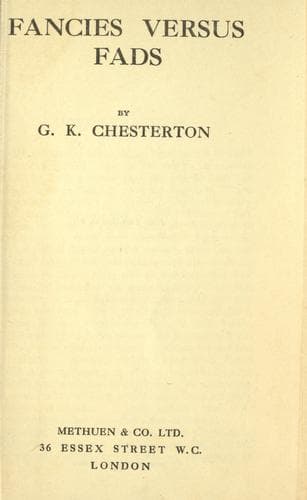
Fancies Versus FadsChesterton, G. K. (Gilbert Keith)
General
Fancies Versus Fads
Chesterton, G. K. (Gilbert Keith)
English essays -- 20th century
In short, if education is really the larger matter, then certainly
domestic life is the larger matter; and official or commercial life the
lesser matter. It is a mere matter of arithmetic that anything taken
from the larger matter will leave it less. It is a mere matter of simple
subtraction that the mother must have less time for the family if she
has more time for the factory. If education, ethical and cultural,
really were a trivial and mechanical matter, the mother might possibly
rattle through it as a rapid routine, before going about her more
serious business of serving a capitalist for hire. If education were
merely instruction, she might briefly instruct her babies in the
multiplication tables, before she mounted to higher and nobler spheres
as the servant of a Milk Trust or the secretary of a Drug Combine. But
the moderns are perpetually assuring us that education is not
instruction; they are perpetually insisting that it is not a mechanical
exercise, and must on no account be an abbreviated exercise. It must go
on at every hour. It must cover every subject. But if it must go on at
all hours, it must not be neglected in business hours. And if the child
is to be free to cover every subject, the parent must be free to cover
every subject too.
For the idea of a non-parental substitute is simply an illusion of
wealth. The advanced advocate of this inconsistent and infinite
education for the child is generally thinking of the rich child; and all
this particular sort of liberty should rather be called luxury. It is
natural enough for a fashionable lady to leave her little daughter with
the French governess or the Czecho-Slovakian governess or the Ancient
Sanskrit governess, and know that one or other of these sides of the
infant’s intelligence is being developed; while she, the mother, figures
in public as a money-lender or some other modern position of dignity.
But among poorer people there cannot be five teachers to one pupil.
Generally there are about fifty pupils to one teacher. There it is
impossible to cut up the soul of a single child and distribute it among
specialists. It is all we can do to tear in pieces the soul of a single
schoolmaster, and distribute it in rags and scraps to a whole mob of
boys. And even in the case of the wealthy child it is by no means clear
that specialists are a substitute for spiritual authority. Even a
millionaire can never be certain that he has not left out one governess,
in the long procession of governesses perpetually passing under his
marble portico; and the omission may be as fatal as that of the king
who forgot to ask the bad fairy to the christening. The daughter, after
a life of ruin and despair, may look back and say, “Had I but also had a
Lithuanian governess, my fate as a diplomatist’s wife in Eastern Europe
would have been very different.” But it seems rather more probable, on
the whole, that what she would miss would not be one or other of these
Public-domain text, read in full here on John Shaqi.
Reviews
Reviews
No reviews yet
Be the first to share your thoughts on this work.
Elsewhere in the archive
Join the Discussion
Join the discussion
Sign in to leave a comment or review.
Sign InorCreate an account