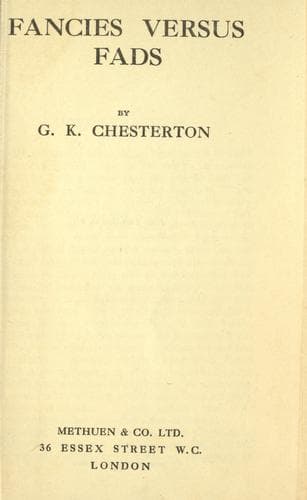
Fancies Versus FadsChesterton, G. K. (Gilbert Keith)
General
Fancies Versus Fads
Chesterton, G. K. (Gilbert Keith)
English essays -- 20th century
In another way there is something of illusion, or of irresponsibility,
about the purely public function, especially in the case of public
education. The educationist generally deals with only one section of the
pupil’s mind. But he always deals with only one section of the pupil’s
life. The parent has to deal, not only with the whole of the child’s
character, but also with the whole of the child’s career. The teacher
sows the seed, but the parent reaps as well as sows. The schoolmaster
sees more children, but it is not clear that he sees more childhood;
certainly he sees less youth and no maturity. The number of little girls
who take prussic acid is necessarily small. The boys who hang themselves
on bed-posts, after a life of crime, are generally the minority. But the
parent has to envisage the whole life of the individual, and not merely
the school life of the scholar. It is not probable that the parent will
exactly anticipate crime and prussic acid as the crown of the infant’s
career. But he will anticipate hearing of the crime if it is committed;
he will probably be told of the suicide if it takes place. It is quite
doubtful whether the schoolmaster or schoolmistress will ever hear of it
at all. Everybody knows that teachers have a harassing and often heroic
task, but it is not unfair to them to remember that in this sense they
have an exceptionally happy task. The cynic would say that the teacher
is happy in never seeing the results of his own teaching. I prefer to
confine myself to saying that he has not the extra worry of having to
estimate it from the other end. The teacher is seldom in at the death.
To take a milder theatrical metaphor, he is seldom there on the night.
But this is only one of many instances of the same truth: that what is
called public life is not larger than private life, but smaller. What
we call public life is a fragmentary affair of sections and seasons and
impressions; it is only in private life that dwells the fullness of our
life bodily.
Strikes and the Spirit of Wonder
Public-domain text, read in full here on John Shaqi.
Reviews
Reviews
No reviews yet
Be the first to share your thoughts on this work.
Elsewhere in the archive
Join the Discussion
Join the discussion
Sign in to leave a comment or review.
Sign InorCreate an account