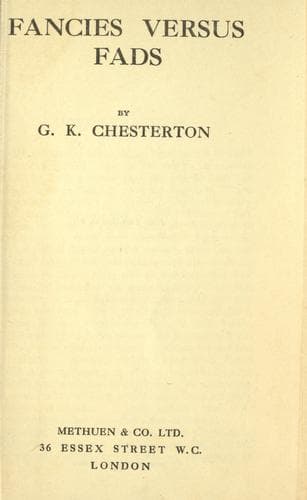
Fancies Versus FadsChesterton, G. K. (Gilbert Keith)
General
Fancies Versus Fads
Chesterton, G. K. (Gilbert Keith)
English essays -- 20th century
There is a story which pleases me so much that I feel sure I have
repeated it in print, about an alleged and perhaps legendary lady
secretary of Madam Blavatsky or Mrs. Besant, who was so much delighted
with a new sofa or ottoman that she sat on it by preference when resting
or reading her correspondence. At last it moved slightly, and she found
it was a Mahatma covered with his Eastern robe and rigid in prayer, or
some more impersonal ecstasy. That a lady secretary should have a seat
any gentleman will approve; that a Mahatma should be sat on no Christian
will deny; nevertheless, there is another possible moral to the fable
which is a reproach rather to the sitter than the seat. It might be put,
as in a sort of vision or allegory, by imagining that all our furniture
really was made thus of living limbs instead of dead sticks. Suppose the
legs of the table were literally legs--the legs of slaves standing
still. Suppose the arms of an armchair really were arms--the arms of a
patient domestic permanently held out, like those of an old nurse
waiting for a baby. It would be calculated to make the luxurious
occupant of the easy-chair feel rather like a baby; which might do him
good. Suppose every sofa were like that of Mrs. Besant’s
secretary--simply made of a man. They need not be made merely of
Theosophists or Buddhists--God forbid. Many of us would greatly prefer
to trust ourselves to a Moslem or Turk. This might, with strict
accuracy, be called sitting on an Ottoman. I have even read, I think, of
some oriental potentate who rejoiced in a name sounding like “sofa.” It
might even be hinted that some of them might be Christians, but there is
no reason, of course, why all of them should not be praying. To sit on a
man while he was praying would doubtless require some confidence. It
would also give a more literal version of the possession of a Prie-Dieu
chair. It would be easy to expand the extravagance into a vision of a
whole house alive, an architecture of arms and legs, a temple of temples
of the spirit. The four walls might be made of men like the squares in
military formation. There is even, perhaps, a shadow of the fantasy in
the popular phrases that compare the roof to the human head, that name
the chimney-pot hat after the chimney, or lightly allude to all modern
masculine head-dresses as “tiles.” But the only value of the vision, as
of most visions--even the most topsy-turvy ones--is a moral value. It
figures forth, in emblem and enigma, the truth that we do treat merely
as furniture a number of people who are, at the very least, live stock.
And the proof of it is that when they move we are startled like the
secretary sitting on the praying man; but perhaps it is we who should
begin to pray.
Public-domain text, read in full here on John Shaqi.
Reviews
Reviews
No reviews yet
Be the first to share your thoughts on this work.
Elsewhere in the archive
Join the Discussion
Join the discussion
Sign in to leave a comment or review.
Sign InorCreate an account