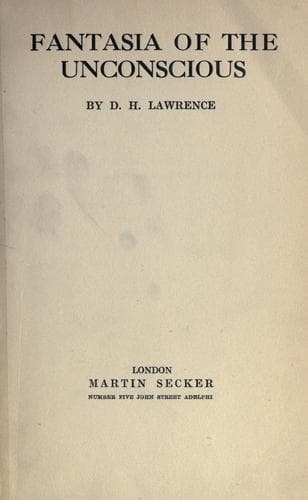
Fantasia of the UnconsciousLawrence, D. H. (David Herbert)
Philosophy
Fantasia of the Unconscious
Lawrence, D. H. (David Herbert)
Psychoanalysis; Sex; Subconsciousness
Why does the dream-process act so? For two reasons. First, the reason
of simple automatic continuance. The mother-image was the first great
emotional image to be introduced in the psyche. The dream-process
mechanically reproduces its stock image the moment the intense
sympathy-emotion is aroused. Again, the mother-image refers only to
the upper plane. But the dream-process is mechanical in its logic.
Because the mother-image refers to the great dynamic stress of the
upper plane, therefore it refers to the great dynamic stress of the
lower. This is a piece of sheer automatic logic. The living soul is
_not_ automatic, and automatic logic does not apply to it.
But for our second reason for the image. In becoming the object of
great emotional stress for her son, the mother also becomes an object
of poignancy, of anguish, of arrest, to her son. She arrests him from
finding his proper fulfillment on the sensual plane. Now it is almost
always the object of arrest which becomes impressed, as it were, upon
the psyche. A man very rarely has an image of a person with whom he is
livingly, vitally connected. He only has dream-images of the persons
who, in some way, _oppose_ his life-flow and his soul's freedom, and
so become impressed upon his plasm as objects of resistance. Once a
man is dynamically caught on the upper plane by mother or sister, then
the dream-image of mother or sister will persist until the dynamic
_rapport_ between himself and his mother or sister is finally broken.
And the dream-image from the upper plane will be automatically applied
to the disturbance of the lower plane.
Because--and this is very important--the dream-process _loves_ its own
automatism. It would force everything to an automatic-logical
conclusion in the psyche. But the living, wakeful psyche is so
flexible and sensitive, it has a horror of automatism. While the soul
really lives, its deepest dread is perhaps the dread of automatism.
For automatism in life is a forestalling of the death process.
The living soul has its great fear. The living soul _fears_ the
automatically logical conclusion of incest. Hence the sleep-process
invariably draws this conclusion. The dream-process, fiendishly, plays
a triumph of automatism over us. But the dream-conclusion is almost
invariably just the _reverse_ of the soul's desire, in any
distress-dream. Popular dream-telling understood this, and pronounced
that you must read dreams backwards. Dream of a wedding, and it means
a funeral. Wish your friend well, and fear his death, and you will
dream of his funeral. Every desire has its corresponding fear that the
desire shall not be fulfilled. It is _fear_ which forms an
arrest-point in the psyche, hence an image. So the dream automatically
produces the fear-image as the desire-image. If you secretly wished
your enemy dead, and feared he might flourish, the dream would present
you with his wedding.
Public-domain text, read in full here on John Shaqi.
Reviews
Reviews
No reviews yet
Be the first to share your thoughts on this work.
Elsewhere in the archive
Join the Discussion
Join the discussion
Sign in to leave a comment or review.
Sign InorCreate an account