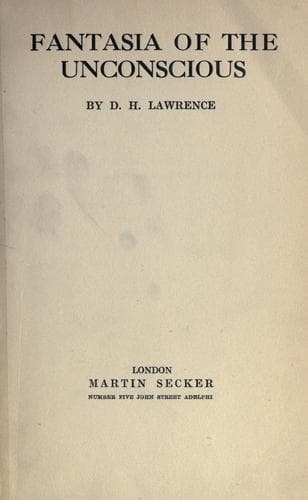
Fantasia of the UnconsciousLawrence, D. H. (David Herbert)
Philosophy
Fantasia of the Unconscious
Lawrence, D. H. (David Herbert)
Psychoanalysis; Sex; Subconsciousness
Examining the emotional reference we find that the feeling is sensual,
there is a great impression of the powerful, almost beautiful physical
bodies of the horses, the nearness, the rounded haunches, the rearing.
Is the dynamic passion in a horse the danger-passion? It is a great
sensual reaction at the sacral ganglion, a reaction of intense,
sensual, dominant volition. The horse which rears and kicks and neighs
madly acts from the intensely powerful sacral ganglion. But this
intense activity from the sacral ganglion is male: the sacral ganglion
is at its highest intensity in the male. So that the horse-dream
refers to some arrest in the deepest sensual activity in the male.
The horse is presented as an object of terror, which means that to the
man's automatic dream-soul, which loves automatism, the great sensual
male activity is the greatest menace. The automatic pseudo-soul, which
has got the sensual nature repressed, would like to keep it repressed.
Whereas the greatest desire of the living spontaneous soul is that
this very male sensual nature, represented as a menace, shall be
actually accomplished in life. The spontaneous self is secretly
yearning for the liberation and fulfillment of the deepest and most
powerful sensual nature. There may be an element of father-complex.
The horse may also refer to the powerful sensual being in the father.
The dream may mean a love of the dreamer for the sensual male who is
his father. But it has nothing to do with _incest_. The love is
probably a just love.
The bull-dream is a curious reversal. In the bull the centers of power
are in the breast and shoulders. The horns of the head are symbols of
this vast power in the upper self. The woman's fear of the bull is a
great terror of the dynamic _upper_ centers in man. The bull's horns,
instead of being phallic, represent the enormous potency of the upper
centers. A woman whose most positive dynamism is in the breast and
shoulders is fascinated by the bull. Her dream-fear of the bull and
his horns which may run into her may be reversed to a significance of
desire for connection, not from the centers of the lower, sensual
self, but from the intense physical centers of the upper body: the
phallus polarized from the upper centers, and directed towards the
great breast center of the woman. Her wakeful fear is terror of the
great breast-and-shoulder, _upper_ rage and power of man, which may
pierce her defenseless lower self. The terror and the desire are near
together--and go with an admiration of the slender, abstracted bull
loins.
Other dream-fears, or strong dream-impressions, may be almost
imageless. They may be a great terror, for example, of a purely
geometric figure--a figure from pure geometry, or an example of pure
mathematics. Or they may have no image, but only a sensation of smell,
or of color, or of sound.
Public-domain text, read in full here on John Shaqi.
Reviews
Reviews
No reviews yet
Be the first to share your thoughts on this work.
Elsewhere in the archive
Join the Discussion
Join the discussion
Sign in to leave a comment or review.
Sign InorCreate an account