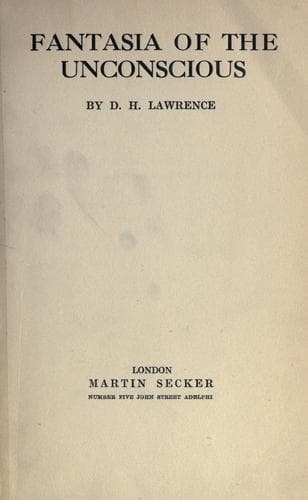
Fantasia of the UnconsciousLawrence, D. H. (David Herbert)
Philosophy
Fantasia of the Unconscious
Lawrence, D. H. (David Herbert)
Psychoanalysis; Sex; Subconsciousness
These are the dream-fears of the soul which is falling out of human
integrity into the purely mechanical mode. If we idealize ourselves
sufficiently, the spontaneous centers do at last work only, or almost
only, in the mechanical mode. They have no dynamic relation with
another being. They cannot have. Their whole power of dynamic
relationship is quenched. They act now in reference purely to the
mechanical world, of force and matter, sensation and law. So that in
dream-activity sensation or abstraction, abstract law or calculation
occurs as the predominant or exclusive image. In the dream there may
be a sensation of admiration or delight. The waking sensation is fear.
Because the soul fears above all things its fall from individual
integrity into the mechanic activity of the outer world, which is the
automatic death-world.
And this is our danger to-day. We tend, through deliberate idealism or
deliberate material purpose, to destroy the soul in its first nature
of spontaneous, integral being, and to substitute the second nature,
the automatic nature of the mechanical universe. For this purpose we
stay up late at night, and we rise late in the morning.
To stay up late into the night is always bad. Let us be as ideal as we
may, when the sun goes down the natural mode of life changes in us.
The mind changes its activity. As the soul gradually goes passive,
before yielding up its sway, the mind falls into its second phase of
activity. It collects the results of the spent day into consciousness,
lays down the honey of quiet thought, or the bitter-sweet honey of the
gathered flower. It is the consciousness of that which is past.
Evening is our time to read history and tragedy and romance--all of
which are the utterance of that which is past, that which is over,
that which is finished, is concluded: either sweetly concluded, or
bitterly. Evening is the time for this.
But evening is the time also for revelry, for drink, for passion.
Alcohol enters the blood and acts as the sun's rays act. It inflames
into life, it liberates into energy and consciousness. But by a
process of combustion. That life of the day which we have not lived,
by means of sun-born alcohol we can now flare into sensation,
consciousness, energy and passion, and live it out. It is a liberation
from the laws of idealism, a release from the restriction of control
and fear. It is the blood bursting into consciousness. But naturally
the course of the liberated consciousness may be in either direction:
sharper mental action, greater fervor of spiritual emotion, or deeper
sensuality. Nowadays the last is becoming much more unusual.
Public-domain text, read in full here on John Shaqi.
Reviews
Reviews
No reviews yet
Be the first to share your thoughts on this work.
Elsewhere in the archive
Join the Discussion
Join the discussion
Sign in to leave a comment or review.
Sign InorCreate an account