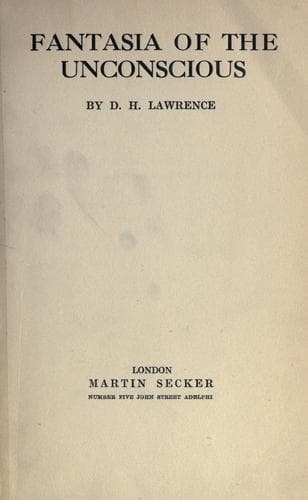
Fantasia of the UnconsciousLawrence, D. H. (David Herbert)
Philosophy
Fantasia of the Unconscious
Lawrence, D. H. (David Herbert)
Psychoanalysis; Sex; Subconsciousness
For a child's primary education depends almost entirely on its
relation to its parents, brothers, and sisters. Between mother and
child, father and child, the law is this: I, the mother, am myself
alone: the child is itself alone. But there exists between us a vital
dynamic relation, for which I, being the conscious one, am basically
responsible. So, as far as possible, there must be in me no departure
from myself, lest I injure the preconscious dynamic relation. I must
absolutely act according to my own true spontaneous feeling. But,
moreover, I must also have wisdom for myself and for my child. Always,
always the deep wisdom of responsibility. And always a brave
responsibility for the soul's own spontaneity. Love--what is love?
We'd better get a new idea. Love is, in all, generous impulse--even a
good spanking. But wisdom is something else, a deep collectedness in
the soul, a deep abiding by my own integral being, which makes me
responsible, not for the child, but for my certain duties towards the
child, and for maintaining the dynamic flow between the child and
myself as genuine as possible: that is to say, not perverted by ideals
or by my _will_.
Most fatal, most hateful of all things is bullying. But what is
bullying? It is a desire to superimpose my own will upon another
person. Sensual bullying of course is fairly easily detected. What is
more dangerous is ideal bullying. Bullying people into what is ideally
good for them. I embrace for example an ideal, and I seek to enact
this ideal in the person of another. This is ideal bullying. A mother
says that life should be all love, all delicacy and forbearance and
gentleness. And she proceeds to spin a hateful sticky web of permanent
forbearance, gentleness, hushedness around her naturally passionate
and hasty child. This so foils the child as to make him half imbecile
or criminal. I may have ideals if I like--even of love and forbearance
and meekness. But I have no right to ask another to have these ideals.
And to impose _any ideals_ upon a child as it grows is almost
criminal. It results in impoverishment and distortion and subsequent
deficiency. In our day, most dangerous is the love and benevolence
ideal. It results in neurasthenia, which is largely a dislocation or
collapse of the great voluntary centers, a derangement of the will. It
is in us an insistence upon the one life-mode only, the spiritual
mode. It is a suppression of the great lower centers, and a living a
sort of half-life, almost entirely from the upper centers. Thence,
since we live terribly and exhaustively from the upper centers, there
is a tendency now towards pthisis and neurasthenia of the heart. The
great sympathetic center of the breast becomes exhausted, the lungs,
burnt by the over-insistence of one way of life, become diseased, the
heart, strained in one mode of dilation, retaliates. The powerful
lower centers are no longer fully active, particularly the great
Public-domain text, read in full here on John Shaqi.
Reviews
Reviews
No reviews yet
Be the first to share your thoughts on this work.
Join the Discussion
Join the discussion
Sign in to leave a comment or review.
Sign InorCreate an account