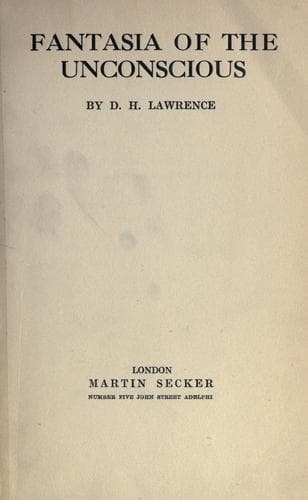
Fantasia of the UnconsciousLawrence, D. H. (David Herbert)
Philosophy
Fantasia of the Unconscious
Lawrence, D. H. (David Herbert)
Psychoanalysis; Sex; Subconsciousness
And as an example--a very simple one--of how a scientist of the most
innocent modern sort may hint at truths which, when stated, he would
laugh at as fantastic nonsense, let us quote a word from the already
old-fashioned "Golden Bough." "It must have appeared to the ancient
Aryan that the sun was periodically recruited from the fire which
resided in the sacred oak."
Exactly. The fire which resided in the Tree of Life. That is, life
itself. So we must read: "It must have appeared to the ancient Aryan
that the sun was periodically recruited from life."--Which is what the
early Greek philosophers were always saying. And which still seems to
me the real truth, the clue to the cosmos. Instead of life being drawn
from the sun, it is the emanation from life itself, that is, from all
the living plants and creatures which nourish the sun.
Of course, my dear critic, the ancient Aryans were just doddering--the
old duffers: or babbling, the babes. But as for me, I have some
respect for my ancestors, and believe they had more up their sleeve
than just the marvel of the unborn me.
One last weary little word. This pseudo-philosophy of
mine--"pollyanalytics," as one of my respected critics might say--is
deduced from the novels and poems, not the reverse. The novels and poems
come unwatched out of one's pen. And then the absolute need which one has
for some sort of satisfactory mental attitude towards oneself and things in
general makes one try to abstract some definite conclusions from one's
experiences as a writer and as a man. The novels and poems are pure
passionate experience. These "pollyanalytics" are inferences made
afterwards, from the experience.
And finally, it seems to me that even art is utterly dependent on
philosophy: or if you prefer it, on a metaphysic. The metaphysic or
philosophy may not be anywhere very accurately stated and may be quite
unconscious, in the artist, yet it is a metaphysic that governs men at
the time, and is by all men more or less comprehended, and lived. Men
live and see according to some gradually developing and gradually
withering vision. This vision exists also as a dynamic idea or
metaphysic--exists first as such. Then it is unfolded into life and
art. Our vision, our belief, our metaphysic is wearing woefully thin,
and the art is wearing absolutely threadbare. We have no future;
neither for our hopes nor our aims nor our art. It has all gone gray
and opaque.
We've got to rip the old veil of a vision across, and find what the
heart really believes in, after all: and what the heart really wants,
for the next future. And we've got to put it down in terms of belief
and of knowledge. And then go forward again, to the fulfillment in
life and art.
Public-domain text, read in full here on John Shaqi.
Reviews
Reviews
No reviews yet
Be the first to share your thoughts on this work.
Join the Discussion
Join the discussion
Sign in to leave a comment or review.
Sign InorCreate an account