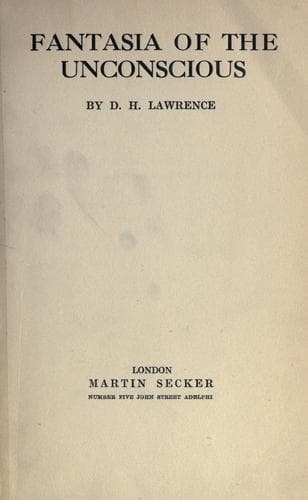
Fantasia of the UnconsciousLawrence, D. H. (David Herbert)
Philosophy
Fantasia of the Unconscious
Lawrence, D. H. (David Herbert)
Psychoanalysis; Sex; Subconsciousness
But we are not confined to one direction only, or to one exclusive
consummation. Was the building of the cathedrals a working up towards
the act of coition? Was the dynamic impulse sexual? No. The sexual
element was present, and important. But not predominant. The same in
the building of the Panama Canal. The sexual impulse, in its widest
form, was a very great impulse towards the building of the Panama
Canal. But there was something else, of even higher importance, and
greater dynamic power.
And what is this other, greater impulse? It is the desire of the human
male to build a world: not "to build a world for you, dear"; but to
build up out of his own self and his own belief and his own effort
something wonderful. Not merely something useful. Something wonderful.
Even the Panama Canal would never have been built _simply_ to let
ships through. It is the pure disinterested craving of the human male
to make something wonderful, out of his own head and his own self, and
his own soul's faith and delight, which starts everything going. This
is the prime motivity. And the motivity of sex is subsidiary to this:
often directly antagonistic.
That is, the essentially religious or creative motive is the first
motive for all human activity. The sexual motive comes second. And
there is a great conflict between the interests of the two, at all
times.
What we want to do, is to trace the creative or religious motive to
its source in the human being, keeping in mind always the near
relationship between the religious motive and the sexual. The two
great impulses are like man and wife, or father and son. It is no use
putting one under the feet of the other.
The great desire to-day is to deny the religious impulse altogether,
or else to assert its absolute alienity from the sexual impulse. The
orthodox religious world says faugh! to sex. Whereupon we thank Freud
for giving them tit for tat. But the orthodox scientific world says
fie! to the religious impulse. The scientist wants to discover a cause
for everything. And there is no cause for the religious impulse. Freud
is with the scientists. Jung dodges from his university gown into a
priest's surplice till we don't know where we are. We prefer Freud's
_Sex_ to Jung's _Libido_ or Bergson's _Elan Vital_. Sex has at least
_some_ definite reference, though when Freud makes sex accountable for
everything he as good as makes it accountable for nothing.
We refuse any _Cause_, whether it be Sex or Libido or Elan Vital or
ether or unit of force or _perpetuum mobile_ or anything else. But
also we feel that we cannot, like Moses, perish on the top of our
present ideal Pisgah, or take the next step into thin air. There we
are, at the top of our Pisgah of ideals, crying _Excelsior_ and trying
to clamber up into the clouds: that is, if we are idealists with the
religious impulse rampant in our breasts. If we are scientists we
practice aeroplane flying or eugenics or disarmament or something
equally absurd.
Public-domain text, read in full here on John Shaqi.
Reviews
Reviews
No reviews yet
Be the first to share your thoughts on this work.
Join the Discussion
Join the discussion
Sign in to leave a comment or review.
Sign InorCreate an account