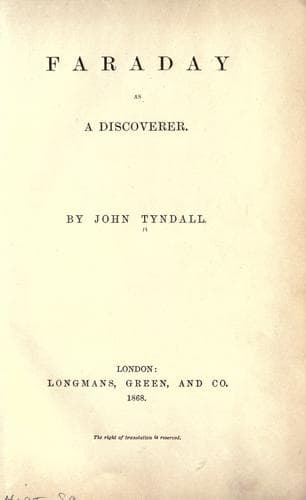
Faraday, Michael, 1791-1867; Physicists -- Great Britain -- Biography
In 1825 Faraday became a member of a committee, to which Sir John
Herschel and Mr. Dollond also belonged, appointed by the Royal Society
to examine, and if possible improve, the manufacture of glass for
optical purposes. Their experiments continued till 1829, when the
account of them constituted the subject of a 'Bakerian Lecture.' This
lectureship, founded in 1774 by Henry Baker, Esq., of the Strand,
London, provides that every year a lecture shall be given before the
Royal Society, the sum of four pounds being paid to the lecturer. The
Bakerian Lecture, however, has long since passed from the region of
pay to that of honour, papers of mark only being chosen for it by
the council of the Society. Faraday's first Bakerian Lecture, 'On the
Manufacture of Glass for Optical Purposes,' was delivered at the
close of 1829. It is a most elaborate and conscientious description of
processes, precautions, and results: the details were so exact and
so minute, and the paper consequently so long, that three successive
sittings of the Royal Society were taken up by the delivery of the
lecture.[3] This glass did not turn out to be of important practical
use, but it happened afterwards to be the foundation of two of Faraday's
greatest discoveries.[4]
The experiments here referred to were commenced at the Falcon Glass
Works, on the premises of Messrs. Green and Pellatt, but Faraday could
not conveniently attend to them there. In 1827, therefore, a furnace was
erected in the yard of the Royal Institution; and it was at this time,
and with a view of assisting him at the furnace, that Faraday engaged
Sergeant Anderson, of the Royal Artillery, the respectable, truthful,
and altogether trustworthy man whose appearance here is so fresh in our
memories. Anderson continued to be the reverential helper of Faraday and
the faithful servant of this Institution for nearly forty years.[5]
In 1831 Faraday published a paper, 'On a peculiar class of Optical
Deceptions,' to which I believe the beautiful optical toy called the
Chromatrope owes its origin. In the same year he published a paper on
Vibrating Surfaces, in which he solved an acoustical problem which,
though of extreme simplicity when solved, appears to have baffled many
eminent men. The problem was to account for the fact that light bodies,
such as the seed of lycopodium, collected at the vibrating parts of
sounding plates, while sand ran to the nodal lines. Faraday showed that
the light bodies were entangled in the little whirlwinds formed in the
air over the places of vibration, and through which the heavier sand
was readily projected. Faraday's resources as an experimentalist were so
wonderful, and his delight in experiment was so great, that he sometimes
almost ran into excess in this direction. I have heard him say that this
paper on vibrating surfaces was too heavily laden with experiments.
Footnotes to Chapter 2
Public-domain text, read in full here on John Shaqi.
Reviews
Reviews
No reviews yet
Be the first to share your thoughts on this work.
Join the Discussion
Join the discussion
Sign in to leave a comment or review.
Sign InorCreate an account