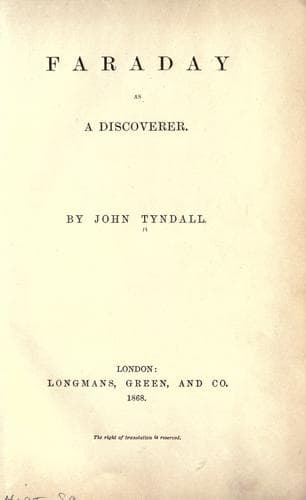
Faraday, Michael, 1791-1867; Physicists -- Great Britain -- Biography
In our conceptions and reasonings regarding the forces of nature,
we perpetually make use of symbols which, when they possess a high
representative value, we dignify with the name of theories. Thus,
prompted by certain analogies, we ascribe electrical phenomena to the
action of a peculiar fluid, sometimes flowing, sometimes at rest. Such
conceptions have their advantages and their disadvantages; they afford
peaceful lodging to the intellect for a time, but they also circumscribe
it, and by-and-by, when the mind has grown too large for its lodging, it
often finds difficulty in breaking down the walls of what has become its
prison instead of its home.[1]
No man ever felt this tyranny of symbols more deeply than Faraday, and
no man was ever more assiduous than he to liberate himself from them,
and the terms which suggested them. Calling Dr. Whewell to his aid
in 1833, he endeavoured to displace by others all terms tainted by
a foregone conclusion. His paper on Electro-chemical Decomposition,
received by the Royal Society on January 9, 1834, opens with the
proposal of a new terminology. He would avoid the word 'current' if he
could.[2] He does abandon the word 'poles' as applied to the ends of
a decomposing cell, because it suggests the idea of attraction,
substituting for it the perfectly natural term Electrodes. He applied
the term Electrolyte to every substance which can be decomposed by the
current, and the act of decomposition he called Electrolysis. All these
terms have become current in science. He called the positive electrode
the Anode, and the negative one the Cathode, but these terms, though
frequently used, have not enjoyed the same currency as the others. The
terms Anion and Cation, which he applied to the constituents of the
decomposed electrolyte, and the term Ion, which included both anions and
cations, are still less frequently employed.
Public-domain text, read in full here on John Shaqi.
Reviews
Reviews
No reviews yet
Be the first to share your thoughts on this work.
Join the Discussion
Join the discussion
Sign in to leave a comment or review.
Sign InorCreate an account