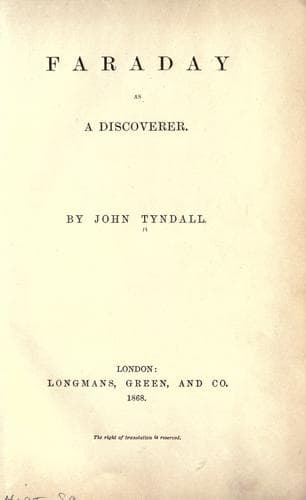
Faraday, Michael, 1791-1867; Physicists -- Great Britain -- Biography
Isolated observations by Brugmanns, Becquerel, Le Baillif, Saigy, and
Seebeck had indicated the existence of a repulsive force exercised by
the magnet on two or three substances; but these observations, which
were unknown to Faraday, had been permitted to remain without extension
or examination. Having laid hold of the fact of repulsion, Faraday
immediately expanded and multiplied it. He subjected bodies of the most
varied qualities to the action of his magnet:--mineral salts, acids,
alkalis, ethers, alcohols, aqueous solutions, glass, phosphorus,
resins, oils, essences, vegetable and animal tissues, and found them
all amenable to magnetic influence. No known solid or liquid proved
insensible to the magnetic power when developed in sufficient strength.
All the tissues of the human body, the blood--though it contains
iron--included, were proved to be diamagnetic. So that if you could
suspend a man between the poles of a magnet, his extremities would
retreat from the poles until his length became equatorial.
Soon after he had commenced his researches on diamagnetism, Faraday
noticed a remarkable phenomenon which first crossed my own path in the
following way: In the year 1849, while working in the cabinet of my
friend, Professor Knoblauch, of Marburg, I suspended a small copper coin
between the poles of an electro-magnet. On exciting the magnet, the coin
moved towards the poles and then suddenly stopped, as if it had struck
against a cushion. On breaking the circuit, the coin was repelled, the
revulsion being so violent as to cause it to spin several times round
its axis of suspension. A Silber-groschen similarly suspended exhibited
the same deportment. For a moment I thought this a new discovery; but on
looking over the literature of the subject, it appeared that Faraday
had observed, multiplied, and explained the same effect during his
researches on diamagnetism. His explanation was based upon his own great
discovery of magneto-electric currents. The effect is a most singular
one. A weight of several pounds of copper may be set spinning between
the electro-magnetic poles; the excitement of the magnet instantly stops
the rotation. Though nothing is apparent to the eye, the copper, if
moved in the excited magnetic field, appears to move through a viscous
fluid; while, when a flat piece of the metal is caused to pass to and
fro like a saw between the poles, the sawing of the magnetic field
resembles the cutting through of cheese or butter.[1] This virtual
friction of the magnetic field is so strong, that copper, by its rapid
rotation between the poles, might probably be fused. We may easily
dismiss this experiment by saying that the heat is due to the electric
currents excited in the copper. But so long as we are unable to reply
to the question, 'What is an electric current?' the explanation is only
provisional. For my own part, I look with profound interest and hope on
the strange action here referred to.
Public-domain text, read in full here on John Shaqi.
Reviews
Reviews
No reviews yet
Be the first to share your thoughts on this work.
Join the Discussion
Join the discussion
Sign in to leave a comment or review.
Sign InorCreate an account