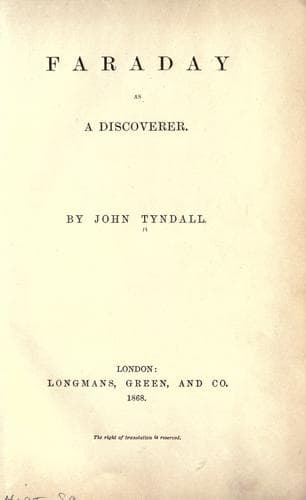
Faraday, Michael, 1791-1867; Physicists -- Great Britain -- Biography
Let us follow out this notion; consider, he argues, the case of a
non-conductor of electricity, such for example as shell-lac, with its
molecules, and intermolecular spaces running through the mass. In its
case space must be an insulator; for if it were a conductor it would
resemble 'a fine metallic web,' penetrating the lac in every direction.
But the fact is that it resembles the wax of black sealing-wax, which
surrounds and insulates the particles of conducting carbon, interspersed
throughout its mass. In the case of shell-lac, therefore, space is an
insulator.
But now, take the case of a conducting metal. Here we have, as before,
the swathing of space round every atom. If space be an insulator there
can be no transmission of electricity from atom to atom. But there is
transmission; hence space is a conductor. Thus he endeavours to hamper
the atomic theory. 'The reasoning,' he says, 'ends in a subversion of
that theory altogether; for if space be an insulator it cannot exist
in conducting bodies, and if it be a conductor it cannot exist in
insulating bodies. Any ground of reasoning,' he adds, as if carried away
by the ardour of argument, 'which tends to such conclusions as these
must in itself be false.'
He then tosses the atomic theory from horn to horn of his dilemmas. What
do we know, he asks, of the atom apart from its force? You imagine a
nucleus which may be called a, and surround it by forces which may
be called m; 'to my mind the a or nucleus vanishes, and the substance
consists in the powers of m. And indeed what notion can we form of the
nucleus independent of its powers? What thought remains on which to hang
the imagination of an a independent of the acknowledged forces?' Like
Boscovich, he abolishes the atom, and puts a 'centre of force' in its
place.
With his usual courage and sincerity he pushes his view to its utmost
consequences. 'This view of the constitution of matter,' he continues,
'would seem to involve necessarily the conclusion that matter fills
all space, or at least all space to which gravitation extends; for
gravitation is a property of matter dependent on a certain force, and it
is this force which constitutes the matter. In that view matter is
not merely mutually penetrable;[1] but each atom extends, so to say,
throughout the whole of the solar system, yet always retaining its own
centre of force.'
Public-domain text, read in full here on John Shaqi.
Reviews
Reviews
No reviews yet
Be the first to share your thoughts on this work.
Elsewhere in the archive
Join the Discussion
Join the discussion
Sign in to leave a comment or review.
Sign InorCreate an account