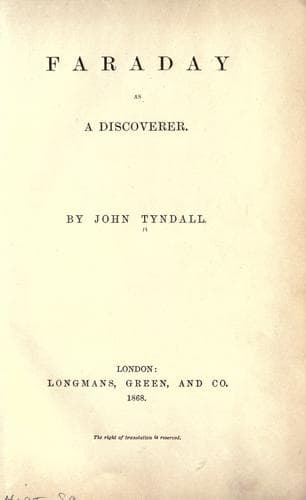
Faraday, Michael, 1791-1867; Physicists -- Great Britain -- Biography
It is the operation of a mind filled with thoughts of this profound,
strange, and subtle character that we have to take into account in
dealing with Faraday's later researches. A similar cast of thought
pervades a letter addressed by Faraday to Mr. Richard Phillips, and
published in the 'Philosophical Magazine' for May, 1846. It is entitled
'Thoughts on Ray-vibrations,' and it contains one of the most singular
speculations that ever emanated from a scientific mind. It must be
remembered here, that though Faraday lived amid such speculations he did
not rate them highly, and that he was prepared at any moment to change
them or let them go. They spurred him on, but they did not hamper him.
His theoretic notions were fluent; and when minds less plastic than his
own attempted to render those fluxional images rigid, he rebelled. He
warns Phillips moreover, that from first to last, 'he merely threw out
as matter for speculation the vague impressions of his mind; for he gave
nothing as the result of sufficient consideration, or as the settled
conviction, or even probable conclusion at which he had arrived.'
The gist of this communication is that gravitating force acts in lines
across space, and that the vibrations of light and radiant heat consist
in the tremors of these lines of force. 'This notion,' he says, 'as far
as it is admitted, will dispense with the ether, which, in another view
is supposed to be the medium in which these vibrations take place.' And
he adds further on, that his view 'endeavours to dismiss the ether but
not the vibrations.' The idea here set forth is the natural supplement
of his previous notion, that it is gravitating force which constitutes
matter, each atom extending, so to say, throughout the whole of the
solar system.
The letter to Mr. Phillips winds up with this beautiful conclusion:--
'I think it likely that I have made many mistakes in the preceding
pages, for even to myself my ideas on this point appear only as the
shadow of a speculation, or as one of those impressions upon the mind
which are allowable for a time as guides to thought and research. He who
labours in experimental inquiries, knows how numerous these are, and how
often their apparent fitness and beauty vanish before the progress and
development of real natural truth.'
Public-domain text, read in full here on John Shaqi.
Reviews
Reviews
No reviews yet
Be the first to share your thoughts on this work.
Elsewhere in the archive
Join the Discussion
Join the discussion
Sign in to leave a comment or review.
Sign InorCreate an account