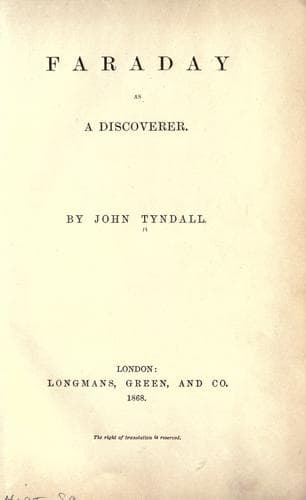
Faraday, Michael, 1791-1867; Physicists -- Great Britain -- Biography
All the results here described were obtained with moving metals. 'But,'
he continues with profound sagacity, 'mere motion would not generate a
relation, which had not a foundation in the existence of some previous
state; and therefore the quiescent metals must be in some relation to
the active centre of force,' that is to the magnet. He here touches the
core of the whole question, and when we can state the condition into
which the conducting wire is thrown before it is moved, we shall then
be in a position to understand the physical constitution of the electric
current generated by its motion.
In this inquiry Faraday worked with steel magnets, the force of which
varies with the distance from the magnet. He then sought a uniform field
of magnetic force, and found it in space as affected by the magnetism
of the earth. His next memoir, sent to the Royal Society, December 31,
1851, is 'on the employment of the Induced Magnetoelectro Current as a
test and measure of magnetic forces.' He forms rectangles and rings, and
by ingenious and simple devices collects the opposed currents which are
developed in them by rotation across the terrestrial lines of magnetic
force. He varies the shapes of his rectangles while preserving their
areas constant, and finds that the constant area produces always the
same amount of current per revolution. The current depends solely on
the number of lines of force intersected, and when this number is kept
constant the current remains constant too. Thus the lines of magnetic
force are continually before his eyes, by their aid he colligates his
facts, and through the inspirations derived from them he vastly expands
the boundaries of our experimental knowledge. The beauty and exactitude
of the results of this investigation are extraordinary. I cannot
help thinking while I dwell upon them, that this discovery of
magneto-electricity is the greatest experimental result ever obtained by
an investigator. It is the Mont Blanc of Faraday's own achievements.
He always worked at great elevations, but a higher than this he never
subsequently attained.
Footnotes to Chapter 13
[1] He compares the interpenetration of two atoms to the
coalescence of two distinct waves, which though for a moment
blended to a single mass, preserve their individuality, and
afterwards separate.
[2] In this form the experiment is identical with one made
twenty years earlier. See page 34.
Chapter 14.
Unity and convertibility of natural forces: theory of the
electric current.
Public-domain text, read in full here on John Shaqi.
Reviews
Reviews
No reviews yet
Be the first to share your thoughts on this work.
Elsewhere in the archive
Join the Discussion
Join the discussion
Sign in to leave a comment or review.
Sign InorCreate an account