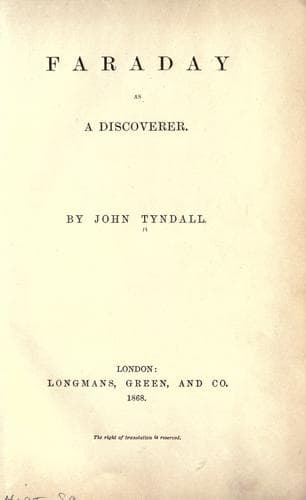
Faraday, Michael, 1791-1867; Physicists -- Great Britain -- Biography
The terms unity and convertibility, as applied to natural forces, are
often employed in these investigations, many profound and beautiful
thoughts respecting these subjects being expressed in Faraday's memoirs.
Modern inquiry has, however, much augmented our knowledge of the
relationship of natural forces, and it seems worth while to say a few
words here, tending to clear up certain misconceptions which appear to
exist among philosophic writers regarding this relationship.
The whole stock of energy or working-power in the world consists of
attractions, repulsions, and motions. If the attractions and repulsions
are so circumstanced as to be able to produce motion, they are sources
of working-power, but not otherwise. Let us for the sake of simplicity
confine our attention to the case of attraction. The attraction exerted
between the earth and a body at a distance from the earth's surface is
a source of working-power; because the body can be moved by the
attraction, and in falling to the earth can perform work. When it rests
upon the earth's surface it is not a source of power or energy, because
it can fall no further. But though it has ceased to be a source of
energy, the attraction of gravity still acts as a force, which holds the
earth and weight together.
The same remarks apply to attracting atoms and molecules. As long as
distance separates them, they can move across it in obedience to the
attraction, and the motion thus produced may, by proper appliances,
be caused to perform mechanical work. When, for example, two atoms of
hydrogen unite with one of oxygen, to form water the atoms are first
drawn towards each other--they move, they clash, and then by virtue of
their resiliency, they recoil and quiver. To this quivering motion
we give the name of heat. Now this quivering motion is merely the
redistribution of the motion produced by the chemical affinity; and this
is the only sense in which chemical affinity can be said to be converted
into heat. We must not imagine the chemical attraction destroyed, or
converted into anything else. For the atoms, when mutually clasped to
form a molecule of water, are held together by the very attraction which
first drew them towards each other. That which has really been expended
is the pull exerted through the space by which the distance between the
atoms has been diminished.
Public-domain text, read in full here on John Shaqi.
Reviews
Reviews
No reviews yet
Be the first to share your thoughts on this work.
Elsewhere in the archive
Join the Discussion
Join the discussion
Sign in to leave a comment or review.
Sign InorCreate an account