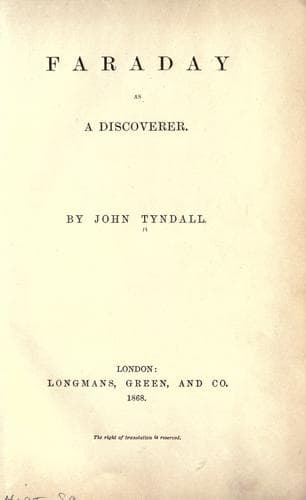
Faraday, Michael, 1791-1867; Physicists -- Great Britain -- Biography
If this be understood, it will be at once seen that gravity may in this
sense be said to be convertible into heat; that it is in reality no more
an outstanding and inconvertible agent, as it is sometimes stated to
be, than chemical affinity. By the exertion of a certain pull, through
a certain space, a body is caused to clash with a certain definite
velocity against the earth. Heat is thereby developed, and this is the
only sense in which gravity can be said to be converted into heat. In no
case is the force which produces the motion annihilated or changed into
anything else. The mutual attraction of the earth and weight exists when
they are in contact as when they were separate; but the ability of that
attraction to employ itself in the production of motion does not exist.
The transformation, in this case, is easily followed by the mind's
eye. First, the weight as a whole is set in motion by the attraction
of gravity. This motion of the mass is arrested by collision with the
earth; being broken up into molecular tremors, to which we give the name
of heat.
And when we reverse the process, and employ those tremors of heat to
raise a weight, as is done through the intermediation of an elastic
fluid in the steam-engine, a certain definite portion of the molecular
motion is destroyed in raising the weight. In this sense, and this
sense only, can the heat be said to be converted into gravity, or
more correctly, into potential energy of gravity. It is not that the
destruction of the heat has created any new attraction, but simply that
the old attraction has now a power conferred upon it, of exerting a
certain definite pull in the interval between the starting-point of the
falling weight and its collision with the earth.
So also as regards magnetic attraction: when a sphere of iron placed
at some distance from a magnet rushes towards the magnet, and has its
motion stopped by collision, an effect mechanically the same as that
produced by the attraction of gravity occurs. The magnetic attraction
generates the motion of the mass, and the stoppage of that motion
produces heat. In this sense, and in this sense only, is there a
transformation of magnetic work into heat. And if by the mechanical
action of heat, brought to bear by means of a suitable machine, the
sphere be torn from the magnet and again placed at a distance, a power
of exerting a pull through that distance, and producing a new motion of
the sphere, is thereby conferred upon the magnet; in this sense, and in
this sense only, is the heat converted into magnetic potential energy.
Public-domain text, read in full here on John Shaqi.
Reviews
Reviews
No reviews yet
Be the first to share your thoughts on this work.
Elsewhere in the archive
Join the Discussion
Join the discussion
Sign in to leave a comment or review.
Sign InorCreate an account