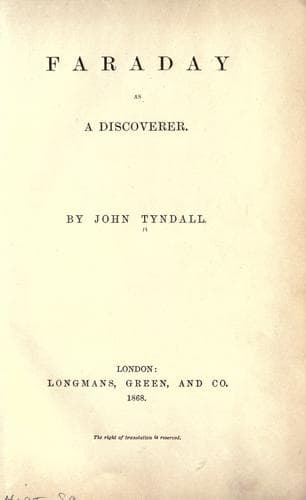
Faraday, Michael, 1791-1867; Physicists -- Great Britain -- Biography
F. You certainly have received a reprimand, Tyndall; but the matter is
over, and if you wish to accept the reproof, you will hear no more about
it.
T. But I do not wish to accept it.
F. Then you know what the consequence of sending that letter will be?
T. I do.
F. They will dismiss you.
T. I know it.
F. Then send the letter!
The letter was firm, but respectful; it acknowledged the justice of the
censure, but expressed neither repentance nor regret. Faraday, in
his gracious way, slightly altered a sentence or two to make it more
respectful still. It was duly sent, and on the following day I entered
the Institution with the conviction that my dismissal was there before
me. Weeks, however, passed. At length the well-known envelope appeared,
and I broke the seal, not doubting the contents. They were very
different from what I expected. 'The Secretary of State for War has
received Professor Tyndall's letter, and deems the explanation therein
given perfectly satisfactory.' I have often wished for an opportunity of
publicly acknowledging this liberal treatment, proving, as it did, that
Lord Panmure could discern and make allowance for a good intention,
though it involved an offence against routine. For many years
subsequently it was my privilege to act under that excellent body, the
Council for Military Education.
On another occasion of this kind, having encouraged me in a somewhat
hardy resolution I had formed, Faraday backed his encouragement by an
illustration drawn from his own life. The subject will interest you, and
it is so sure to be talked about in the world, that no avoidable harm
can rise from its introduction here.
Public-domain text, read in full here on John Shaqi.
Reviews
Reviews
No reviews yet
Be the first to share your thoughts on this work.
Elsewhere in the archive
Join the Discussion
Join the discussion
Sign in to leave a comment or review.
Sign InorCreate an account