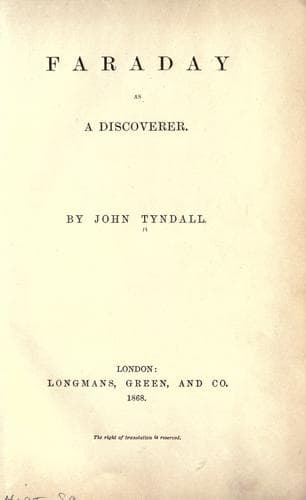
Faraday, Michael, 1791-1867; Physicists -- Great Britain -- Biography
In the year 1835, Sir Robert Peel wished to offer Faraday a pension, but
that great statesman quitted office before he was able to realise his
wish. The Minister who founded these pensions intended them, I believe,
to be marks of honour which even proud men might accept without
compromise of independence. When, however, the intimation first
reached Faraday in an unofficial way, he wrote a letter announcing his
determination to decline the pension; and stating that he was quite
competent to earn his livelihood himself. That letter still exists, but
it was never sent, Faraday's repugnance having been overruled by
his friends. When Lord Melbourne came into office, he desired to see
Faraday; and probably in utter ignorance of the man--for unhappily for
them and us, Ministers of State in England are only too often ignorant
of great Englishmen--his Lordship said something that must have deeply
displeased his visitor. All the circumstances were once communicated to
me, but I have forgotten the details. The term 'humbug,' I think, was
incautiously employed by his Lordship, and other expressions were used
of a similar kind. Faraday quitted the Minister with his own resolves,
and that evening he left his card and a short and decisive note at the
residence of Lord Melbourne, stating that he had manifestly mistaken his
Lordship's intention of honouring science in his person, and declining
to have anything whatever to do with the proposed pension. The
good-humoured nobleman at first considered the matter a capital joke;
but he was afterwards led to look at it more seriously. An excellent
lady, who was a friend both to Faraday and the Minister, tried to
arrange matters between them; but she found Faraday very difficult to
move from the position he had assumed. After many fruitless efforts, she
at length begged of him to state what he would require of Lord Melbourne
to induce him to change his mind. He replied, 'I should require from his
Lordship what I have no right or reason to expect that he would grant--a
written apology for the words he permitted himself to use to me.' The
required apology came, frank and full, creditable, I thought, alike to
the Prime Minister and the philosopher.
Public-domain text, read in full here on John Shaqi.
Reviews
Reviews
No reviews yet
Be the first to share your thoughts on this work.
Elsewhere in the archive
Join the Discussion
Join the discussion
Sign in to leave a comment or review.
Sign InorCreate an account