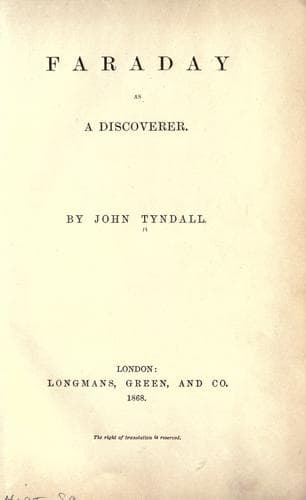
Faraday, Michael, 1791-1867; Physicists -- Great Britain -- Biography
Considering the enormous strain imposed on Faraday's intellect, the
boy-like buoyancy even of his later years was astonishing. He was often
prostrate, but he had immense resiliency, which he brought into action
by getting away from London whenever his health failed. I have already
indicated the thoughts which filled his mind during the evening of his
life. He brooded on magnetic media and lines of force; and the great
object of the last investigation he ever undertook was the decision of
the question whether magnetic force requires time for its propagation.
How he proposed to attack this subject we may never know. But he has
left some beautiful apparatus behind; delicate wheels and pinions,
and associated mirrors, which were to have been employed in the
investigation. The mere conception of such an inquiry is an illustration
of his strength and hopefulness, and it is impossible to say to what
results it might have led him. But the work was too heavy for his tired
brain. It was long before he could bring himself to relinquish it and
during this struggle he often suffered from fatigue of mind. It was at
this period, and before he resigned himself to the repose which marked
the last two years of his life, that he wrote to me the following
letter--one of many priceless letters now before me--which reveals, more
than anything another pen could express, the state of his mind at the
time. I was sometimes censured in his presence for my doings in the
Alps, but his constant reply was, 'Let him alone, he knows how to take
care of himself.' In this letter, anxiety on this score reveals itself
for the first time.
'Hampton Court, August 1, 1864.
'My Dear Tyndall,--I do not know whether my letter will catch you, but I
will risk it, though feeling very unfit to communicate with a man whose
life is as vivid and active as yours; but the receipt of your kind
letter makes me to know that, though I forget, I am not forgotten, and
though I am not able to remember at the end of a line what was said at
the beginning of it, the imperfect marks will convey to you some sense
of what I long to say. We had heard of your illness through Miss Moore,
and I was therefore very glad to learn that you are now quite well;
do not run too many risks or make your happiness depend too much upon
dangers, or the hunting of them. Sometimes the very thinking of you, and
what you may be about, wearies me with fears, and then the cogitations
pause and change, but without giving me rest. I know that much of this
depends upon my own worn-out nature, and I do not know why I write
it, save that when I write to you I cannot help thinking it, and the
thoughts stand in the way of other matter.
* * * * *
'See what a strange desultory epistle I am writing to you, and yet I
feel so weary that I long to leave my desk and go to the couch.
'My dear wife and Jane desire their kindest remembrances: I hear them in
the next room:... I forget--but not you, my dear Tyndall, for I am
'Ever yours,
Public-domain text, read in full here on John Shaqi.
Reviews
Reviews
No reviews yet
Be the first to share your thoughts on this work.
Elsewhere in the archive
Join the Discussion
Join the discussion
Sign in to leave a comment or review.
Sign InorCreate an account