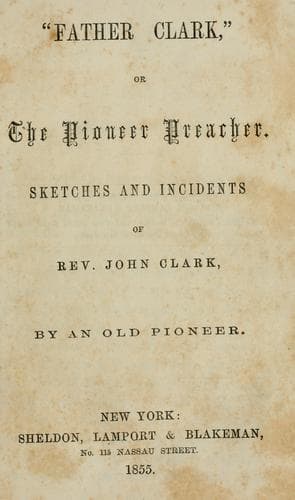
"Father Clark," or The Pioneer PreacherPeck, John Mason
History
"Father Clark," or The Pioneer Preacher
Peck, John Mason
Clark, John, 1758-1833; Methodist Episcopal Church -- Clergy
In the same settlement, and frequently for weeks in succession, at the
cabin of Mr. Lemen, there was an Irish Methodist by the name of William
Murray. His name indicates Scots descent, and he and Mr. Clark were
quite intimate. Indeed, these three men claimed national affinity, for,
as we have shown, Mr. Lemen’s ancestors were from the north of Ireland,
where colonies from Scotland had taken possession in the seventeenth
century. There was just enough diversity in their opinions, to invite
controversy, and enough Christian virtue as a controlling principle to
keep them within the bounds of moderation and fraternal intercourse.
They attended each others meetings, and Mr. Clark preached, and exerted
an influence on the young men in the settlement that has never been
lost.
We will now pass over a few months, till some time in the spring or
summer of 1798, when Mr. Clark carried out his long cherished project
of visiting the Spanish country west of the Mississippi river, and
which made him in a peculiar sense _the pioneer preacher_.
LOUISIANA was discovered, settled, and held in possession by France
until 1762, when, by a secret treaty, it was sold to Spain by that
infamous king, Louis XV, and his more infamous mistress, Madame
Pompadour, and his corrupt ministry. The first permanent settlement
in Upper Louisiana was commenced with the founding of St. Louis as a
trading post in 1764. In 1763, an enterprising trader by the name of
_Pierre Ligueste Laclede_, obtained a grant from the Director General
of Louisiana, with the “necessary powers to trade with the Indians of
the Missouri, and those west of the Mississippi, above the Missouri
river, as far north as the St. Peters,” now Minnesota. A small hamlet
had been previously established by a few French families, and called
St. Genevieve, west of the Great River, and a few miles below the
town of Kaskaskia, and some temporary stations made in the lead mine
country, west of St. Genevieve.
The Spanish authority became regularly established in Upper Louisiana,
in November, 1770. Piernas, the Spanish commandant, arrived in St.
Louis at that date, but there is no official document or record to show
that he exercised the functions of his office previous to February,
1771. Other towns or villages were settled in the vicinity from 1769,
the date of St. Charles, to the period of 1780.
On the transfer of the Illinois country from France to Great Britain
in 1765, many of the French inhabitants removed from that side of the
river to St. Louis and St. Charles, and many more went down the river
to the lower province.
After Colonel George Rogers Clark had taken possession of the Illinois
country, under Virginia, in 1778, he became personally acquainted and
held frequent interviews with French citizens of St. Louis, and the
official authorities.
Public-domain text, read in full here on John Shaqi.
Reviews
Reviews
No reviews yet
Be the first to share your thoughts on this work.
Elsewhere in the archive
Join the Discussion
Join the discussion
Sign in to leave a comment or review.
Sign InorCreate an account