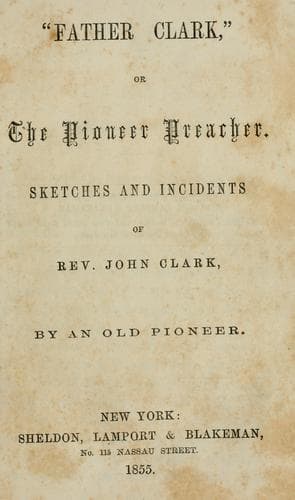
"Father Clark," or The Pioneer PreacherPeck, John Mason
History
"Father Clark," or The Pioneer Preacher
Peck, John Mason
Clark, John, 1758-1833; Methodist Episcopal Church -- Clergy
While at Cahokia, in 1779, only five miles distant, holding treaties
with the Indians from confidential agents whom he sent into the Indian
country northward, he learned that British agents from Canada, with a
large force of northern Indians, were projecting an invasion of St.
Louis. Being on terms of friendly intercourse with Governor Leyba,
the Spanish commandant, he gave him intimation of these treacherous
designs, as he did to several French gentlemen, and tendered his
services with the forces he commanded, in case of an attack. St.
Louis then was enclosed with short palisades, and gates opened in the
pathways that led to the common field, and to the country without.
The sequel gave proof that the governor was a traitor, purchased,
doubtless, with British gold.
In the month of May, 1780, a large band of warriors from different
tribes of Indians from the Upper Mississippi and the northern lakes,
with a number of Canadians, amounting in all to twelve or fourteen
hundred armed men, appeared in the forest east of the Mississippi,
above St. Louis. The 25th of May was the festival of _Corpus Christi_,
a day highly venerated by the inhabitants who were Catholics. Had the
assault been made on that day it would have been fatal to the town; for
after the service in the church, nearly all the inhabitants, men, women
and children, flocked to the prairie to gather strawberries, which were
abundant, and delicious at that season. A few Indians had crossed the
river as spies, and secreted themselves in the thickets near where the
people passed.
Next day the main body crossed the river, and attacked the town. A few
persons who had gone to the field, were attacked from an ambuscade;
some were killed; others fled to the town and gave the alarm. The
soldiers under the command of the Governor, and his subalterns, either
from fear or treachery, hid themselves, and the citizens alone had to
defend the place. They found some government cannon, and fired grape
shot as the invaders approached the gates. A few days previous the
treacherous governor sold all the public ammunition to some traders,
but the people supplied themselves with eight kegs of powder they found
in a trader’s house.
The governor kept within his house, but hearing the firing, and
learning the citizens were making a manful resistance, he came out,
ordered the firing to cease, and the cannon to be spiked and filled
with sand by some of his minions. Fortunately the men at the lower
gate did not hear the peremptory order, and continued the firing.
The governor, perceiving this, ordered a cannon to be fired at them.
They threw themselves on the ground, and the murderous volley of
grape shot passed over their heads. This horrible procedure, with his
general conduct, fixed the indelible brand of traitor on his name, and
such the French citizens reported him to have been, to the immediate
representative of the crown of Spain in New Orleans.
Public-domain text, read in full here on John Shaqi.
Reviews
Reviews
No reviews yet
Be the first to share your thoughts on this work.
Elsewhere in the archive
Join the Discussion
Join the discussion
Sign in to leave a comment or review.
Sign InorCreate an account