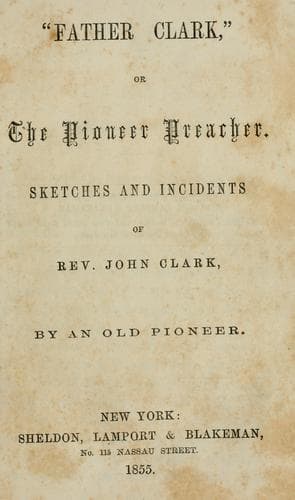
"Father Clark," or The Pioneer PreacherPeck, John Mason
History
"Father Clark," or The Pioneer Preacher
Peck, John Mason
Clark, John, 1758-1833; Methodist Episcopal Church -- Clergy
They were about three months lying off and on, upon cruizing ground,
in the Caribbean Sea, very short of provisions. Their butter, cheese,
flour, lard, and fruit, failed entirely, and much of the time they were
on short allowance, when they joined the fleet lying at St. Lucia. The
force consisted of two squadrons, one commanded by Admiral Parker, the
other by that truly pious Admiral Rolly, as Clark denotes him. The
French fleet lay at Martinique, not far distant, but were too numerous
and powerful to risk an encounter. So the British lay in the harbor,
with springs on their cables, waiting for a reinforcement, and fresh
supplies of provisions and naval stores. The French were waiting to be
reinforced by the Spanish fleet and land-forces from Hispaniola, (now
Hayti,) and both united, purposed to invade the Island of Jamaica. The
British Government, knowing the precarious situation of that valuable
island, made every effort to send relief, but they were hard pressed
by the war in the American Colonies, and they needed an energetic, and
skillful commander, to save their West India possessions.
They had a naval officer of great skill and courage, but he had been
absent many years on the continent of Europe. This was the celebrated
Sir George Brydges Rodney, who had distinguished himself in the West
Indies, in 1761, by the capture of Martinique. He was an admirable
commander in the navy, but while on land, was profligate, and had
wasted his estate, and become hopelessly in debt. In this situation
he left England to reside on the continent of Europe. His biographer
says, “He injured his finances in a contested election for Parliament
in 1768.” The French government made some overtures to him, which would
have repaired his fortune, but he rejected them with indignation, and
remained true to his native country.
Such was the alarming state of affairs in the West Indies that the
government called home Sir G. B. Rodney, paid his debts, redeemed
his estates, and gave him the chief command of the fleet in the West
Indies. This policy, probably, prevented Jamaica from falling into the
hands of France or Spain. Admiral Rodney, with a reinforcement, joined
the fleet at St. Lucia; and, as Clark says, “It was the best equipped
squadron I ever saw.”
Rodney soon captured a Spanish squadron, and used the prisoners with
great humanity. This became known to Charles III., the venerable king
of Spain, and he issued orders to his naval and military officers to
treat all British prisoners humanely.
Public-domain text, read in full here on John Shaqi.
Reviews
Reviews
No reviews yet
Be the first to share your thoughts on this work.
Join the Discussion
Join the discussion
Sign in to leave a comment or review.
Sign InorCreate an account