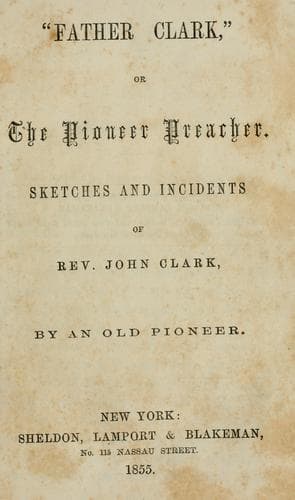
"Father Clark," or The Pioneer PreacherPeck, John Mason
History
"Father Clark," or The Pioneer Preacher
Peck, John Mason
Clark, John, 1758-1833; Methodist Episcopal Church -- Clergy
Soon as the news of the cession of the country to the United States
reached his ears, without waiting for its confirmation by the
government, and the actual transfer, he went across the great river
in the autumn of 1803, and made that country his home. Mr. Musick was
the first preacher of the gospel who, with his family, settled in the
country, became one of the constituents of Fefee’s Creek, and was its
pastor for more than thirty years.
CHAPTER XII.
Forms a Methodist Class in Illinois.--Gradual change of Views.--
Mode of Inquiry.--Circumstances of his Baptism.--Practical
progress in Baptist Principles.--Zeal and influence in promoting
education.--Early Schools in the Illinois country.--A
formidable obstruction to a pupil.--Three fellows in the way.
--Want of books.--A whiskey-loving teacher rightly served.--
Effects of Father Clark’s teaching.--Visits Kentucky again.--
Visits to West Florida.--Interview with a Sick man.--Efficacy
of Prayer.--A Revolution.
We shall now confine our attention entirely to Father Clark. Soon
after he began his regular visits to the Spanish country, he gathered
into a society a small class of disciples, and held regular meetings
with them near Bellefontaine, some three or four miles north of New
Design. He still regarded himself a Methodist, though independent of
that ecclesiastical connection. He was scarcely conscious at that
period, that he was gradually diverging from the peculiarities of
Wesleyism and approaching the fundamental principles of Baptist
faith and practice. He had held his intellect and conscience open to
conviction from the time he left the conference in Georgia, by the
prayerful resolve to follow the Scriptures, and bring all his religious
practice into strict conformity to that divine rule. His habit of
praying in every perplexity, until his mind became satisfied that he
was in the pathway of duty, continued and increased with advancing
years. At the same time, as ever after, he was liberal to all other
Christians, and made no efforts to proselyte them to his own peculiar
views. He explained the Scriptures, and urged on all whom he addressed
in public, or conversed with in private, the duty of studying the Word
of God, and following wherever it led. Christ was ever held up as sole
law-giver in Zion. For several years the conviction had increased that
he was unbaptized, and that by this ordinance more than any other, the
disciples of Christ made a profession of faith in him. He had become
convinced that the ceremony performed in unconscious infancy, by virtue
of some mystical covenant relationship of his parents, and by the
pastor of the church where he was born, was to him no part of Christian
obedience.
Public-domain text, read in full here on John Shaqi.
Reviews
Reviews
No reviews yet
Be the first to share your thoughts on this work.
Elsewhere in the archive
Join the Discussion
Join the discussion
Sign in to leave a comment or review.
Sign InorCreate an account