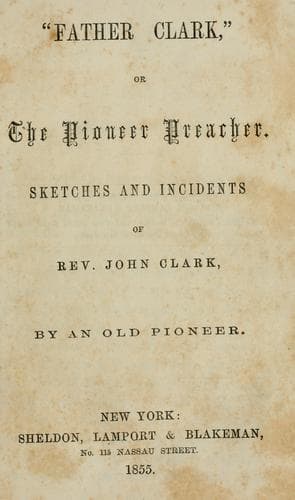
"Father Clark," or The Pioneer PreacherPeck, John Mason
History
"Father Clark," or The Pioneer Preacher
Peck, John Mason
Clark, John, 1758-1833; Methodist Episcopal Church -- Clergy
Mr. Clark from the time he left Georgia had been reading the
Scriptures, to find out the character of a church, such as those
congregations named in Jerusalem, Antioch, Ephesus, Corinth, etc. He
was then a Baptist so far as infant baptism was concerned, and he
doubted much whether any uninspired human authority could change the
form approved by Christ, without destroying the institution. And the
majority of the people, being Baptists, had no use for the parish
priest for that ceremony. The interdiction of spire and bell was no
inconvenience in their simple form of worship. Unlike the Catholic,
their religion had no connection with bell-ringing.
While this disposition of a perplexing question to the commandant
accommodated the American settlers, it gave no legal countenance
to the visits of a preacher from another nation, and a different
religion,--but the people came out to the meetings with less fear of
the prison. Mr. Clark continued his visits nearly every month, which
did not escape the notice of the commandant. He soon learned the
period of his visits, and some two or three days before his return
to Illinois, he never failed to send a threatening message into the
country that, “If Mons. Clark did not leave the Spanish country in
three days, he would be put in the _calabozo_.” So regularly came this
message that it became a standing jest with his friends to enquire,
“Well, brother Clark, when do you go to the _calabozo_?” “In three
days,” would be the reply, which all understood to mean crossing the
river to the Illinois side.
In the autumn of 1801, Rev. Thomas R. Musick, a relative of the Musick
families, came to the province on a visit. His residence then was in
the Green river district in Kentucky, and he had been in a revival of
religion for several months, and about one hundred converts had been
baptized. His brother was the one who petitioned the commandant for
privilege to hold meetings, and his uncle was one of the residents
in the Spanish country. Coming from the midst of an extensive and
powerful revival of religion, he was in the spirit of preaching, and
cared little for the Spanish calabozo. He visited every family, in
which professors of religion were to be found, in the districts of
St. Louis and St. Charles, and during three weeks’ sojourn, preached
fifteen times to congregations assembled in log cabins and in the
woods, on short notice to hear him. He was threatened with the calabozo
repeatedly. In a frontier settlement above St. Charles, he preached the
funeral sermon of a Baptist by name of Brown, from Kentucky, who had
died there that season.
Mr. Musick left the province with the determination to return with
his family and settle there, soon as he could be permitted to remain
and preach the gospel; and with this end in view, he removed to the
settlement of New Design in Illinois.
Public-domain text, read in full here on John Shaqi.
Reviews
Reviews
No reviews yet
Be the first to share your thoughts on this work.
Elsewhere in the archive
Join the Discussion
Join the discussion
Sign in to leave a comment or review.
Sign InorCreate an account