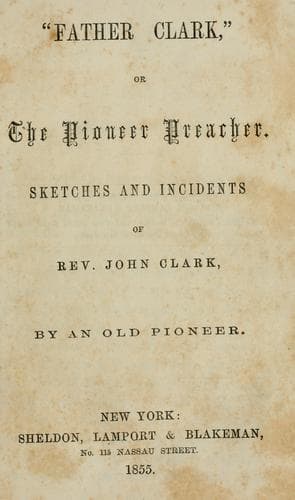
"Father Clark," or The Pioneer PreacherPeck, John Mason
History
"Father Clark," or The Pioneer Preacher
Peck, John Mason
Clark, John, 1758-1833; Methodist Episcopal Church -- Clergy
In one instance, if not in both, Mr. Clark returned on foot from West
Florida to the Illinois country through the intervening wilderness. His
second tour was made by land, and on foot, and he preached wherever
settlements existed, and left a series of appointments, which he
filled on his return. In the Arkansas country he attempted to reach a
settlement, but got lost in the woods and cane-brakes, and wandered for
some hours without finding the signs of a human habitation. He was a
thorough woodsman, but he despaired of finding the way out by his own
skill. Believing in the constant protection of Divine providence, which
he could obtain by prayer, he knelt down by a large tree, and continued
to pray until his mind became calm, and he felt relieved of all
perturbation and anxiety. Pursuing the direction to which he was led by
the impressions of mind he received, he soon came to a path that led
him to a house on the border of the settlement he was trying to find.
West Florida became revolutionized in 1810, and if we rightly
conjecture, at the time or just before the second visit of Father
Clark. That portion of Florida that lay west of the Perdido river,
was originally a part of Louisiana, but the Spanish government held
possession, and the government of the United States, desirous of
avoiding collision with Spain, did not take forcible possession of this
district. In the summer of 1810, the people of the territory, aided
by their friends from Mississippi, effected a successful revolution,
with very little bloodshed. A party of French, headed by Captain George
Depassau, and a party of Americans, commanded by Captain H. Thomas,
made a bold and successful attack on the fort at Baton Rouge, which
surrendered at discretion, and the civil and military authorities of
Spain were permitted to retire to Pensacola. In October the district
was annexed to the United States, by the proclamation of the President,
announcing that William C. C. Clairborne, governor of the territory
of Orleans, was empowered to take possession of West Florida, in the
name of the United States, as a portion of the territory under his
jurisdiction.
While on a visit to this district in 1842, we found persons who had
heard Father Clark preach, and remembered him as a pioneer school
teacher.
On his return from his second tour, he was taken sick, and continued
in a feeble condition for some time. His friends in St. Louis county
hearing of his situation, went after him, and there being no carriage
roads, they hauled him on a sled, dragged by a single horse, through
the wilderness to the settlements near St. Louis.
CHAPTER XIII.
Baptists, “Friends to Humanity.”--Their Anti-slavery position.--
Mr. Clark joins them.--Manner of his reception.--His Views
of African Slavery.--Views of African Colonization.--Made
Life-member of a Colonization Society.--Circulars on Slavery.
--Personal behavior.--Conversational Gifts.--Writes Family
Records.
Public-domain text, read in full here on John Shaqi.
Reviews
Reviews
No reviews yet
Be the first to share your thoughts on this work.
Elsewhere in the archive
Join the Discussion
Join the discussion
Sign in to leave a comment or review.
Sign InorCreate an account