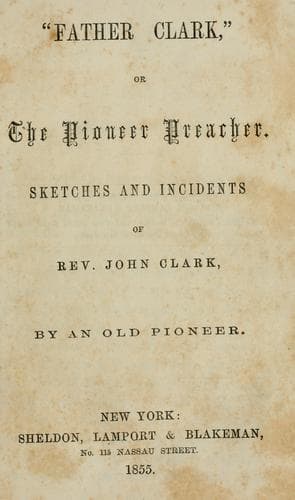
"Father Clark," or The Pioneer PreacherPeck, John Mason
History
"Father Clark," or The Pioneer Preacher
Peck, John Mason
Clark, John, 1758-1833; Methodist Episcopal Church -- Clergy
A class of Baptists had commenced organizing churches, first in
Illinois and then in Missouri, denominated, as a kind of distinction
from other Baptists, as “Friends to Humanity.” They were frequently
called emancipators by others. They were opposed to slavery, and being
desirous of operating in a quiet and peaceful manner against the
commerce in human beings, this class adopted rules by which they were
to be governed in the admission of slave-holders into the churches. The
organization originated in Kentucky, in 1807, and made a division in a
small association in Illinois in 1809. They would not receive persons
to membership “whose practice appeared friendly to perpetual slavery;”
that is, those who justified the holding of human beings as property,
on the same grounds of right as they claimed their horses or other
kinds of property. They did admit to membership in the churches of
Christ slave-holders under the following exceptions.
1. Persons holding young slaves, and recording a deed of
emancipation at such an age as the church should agree to.
2. Persons who had purchased slaves in their ignorance, and who are
willing the church should decide when they shall be free.
3. Women who have no legal power to liberate slaves.
4. Those that held slaves who from age, debility, insanity, or
idiotcy were unfit for emancipation. And they add, “some other
cases which we would wish the churches to judge of, agreeable to
the principles of humanity.”
These Baptists differed widely from modern abolitionists of the
Northern States and England, at least in the following particulars.
1. They never adopted the dogma that slave-holding is a “sin _per
se_,”--a sin in itself, irrespective of all the circumstances in
which the parties might be providentially placed. Hence they could
consistently buy slaves and prepare them for freedom; or contribute
funds to enable slaves to purchase themselves, with a clear conscience.
2. They never aided fugitive slaves to escape from their masters, or
secreted them, in violation of the constitution and laws of the land.
3. They never interfered in any objectionable way, with the legal and
political rights of slave-holders. They preached the gospel in an
acceptable and successful manner among slave-holders.
4. They aimed to do good both to master and servant, in a quiet, lawful
and peaceable mode.
5. They endeavored to consult the true interests of all parties
concerned.
6. They ever upheld the constitution and laws of the country in a
peaceful way. Some of this class were chosen to official stations in
both the territory and state of Illinois, and took the oath to support
the constitution and laws of the United States without quibbling and
evasion.
Their general faith and practice corresponded with the principles of
Baptists in general Union.
Public-domain text, read in full here on John Shaqi.
Reviews
Reviews
No reviews yet
Be the first to share your thoughts on this work.
Elsewhere in the archive
Join the Discussion
Join the discussion
Sign in to leave a comment or review.
Sign InorCreate an account