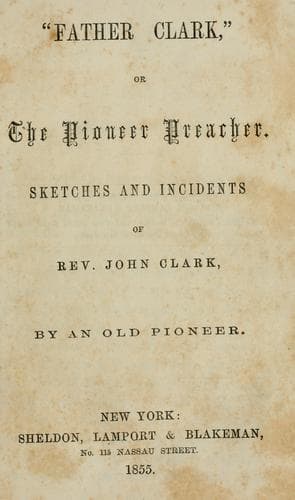
"Father Clark," or The Pioneer PreacherPeck, John Mason
History
"Father Clark," or The Pioneer Preacher
Peck, John Mason
Clark, John, 1758-1833; Methodist Episcopal Church -- Clergy
His views on African slavery gradually acquired firmness and
consistency. We have traced his convictions on this subject to his
exquisite sense of human rights, his innate principles of natural
liberty, his sympathies with afflicted and oppressed humanity,
his own deprivation of liberty by the British press-gang, and his
imprisonment for nineteen months by the Spaniards in Havana. In a
personal acquaintance of fifteen years, and the examination of various
fugitive papers, we find no confusion of thought, and no lack of just
conceptions of the subject. His intercourse with slave-holders was
ever courteous and kind. He never obtruded his opinions where no good
impressions could be made, nor in any way disguised his sentiments
before any person. His frankness and candor were so well known, that
all classes had entire confidence in his motives and mode of treating
this subject.
When the subject of the colonization of free colored persons in Africa
was brought to his mind by the formation of the American Colonization
Society, he hailed it as an omen of good. He understood the strong
objections to the emancipation of slaves remaining amongst us. He
understood well the prejudices against the peculiarities of the African
race, as one of the barriers to amalgamation with white people, and
amidst the gloom that surrounded the hopeless bondage of that race,
he saw one luminous spot in the moral hemisphere. The star of hope
appeared to him to arise in Africa. The finger of providence pointed
in that direction, and he abounded in faith and prayer for success
in the enterprise. He was not so visionary as to imagine there would
be no defects in its management, or no drawbacks in the colonization
movement. He well understood it was an object not to be accomplished
in one generation, and that its influence upon emancipation must be
gradual and indirect. He desired to have an influence produced in the
minds of slave-holders towards the moral and religious interests of the
slaves.
So long known and so well understood were his anti-slavery principles,
and his interest in the colonization scheme as the means of removing
one of the most formidable obstructions to emancipation, that the
ladies of Lofton’s prairie, then in Greene, (now Jersey) county,
Illinois, one of his monthly preaching stations, paid him the
compliment of making him a life member of the county auxiliary
society.[55]
Mr. Clark wrote several circulars for the annual association of
Baptists, to which he belonged, on the subject of Slavery, which were
published in their minutes. They were dictated by a courteous and
christian-like spirit, plain, pointed, impressive and efficacious.
Public-domain text, read in full here on John Shaqi.
Reviews
Reviews
No reviews yet
Be the first to share your thoughts on this work.
Elsewhere in the archive
Join the Discussion
Join the discussion
Sign in to leave a comment or review.
Sign InorCreate an account