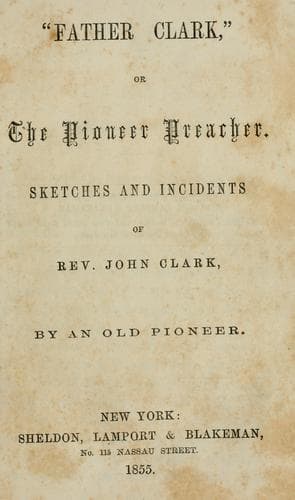
"Father Clark," or The Pioneer PreacherPeck, John Mason
History
"Father Clark," or The Pioneer Preacher
Peck, John Mason
Clark, John, 1758-1833; Methodist Episcopal Church -- Clergy
Mr. Clark had gradually become a Baptist in all respects. For eight or
ten years after he had been baptized in the manner already described,
he remained in an independent position. With the exception of his
visits to the lower country, the larger portion of his time he spent
on the western side of the Mississippi, with occasional visits to his
Illinois friends. The members that remained of the society he organized
near Bellefontaine in Illinois, had attached themselves to other
churches,--some to the Baptists, and others to the Methodist Episcopal
church. Those about the Spanish pond and Coldwater settlements in St.
Louis county gradually became Baptists, and regarded him as their
pastor and spiritual guide. For some years he watched the course of
his old friends, the Lemens’ and others of that class. He felt deeply
interested in their anti-slavery position. Their quiet, unobtrusive
method of managing the perplexing question of slavery corresponded with
his own views and experience. The father, his old friend and associate,
had become an ordained minister, and two of his sons, who had studied
under Mr. Clark, were now heads of families, and joint pastors of
Cantine, (now Bethel) church, and, with their compeers in the ministry,
were performing much itinerant service in the destitute settlements.
Benjamin, the eldest son of Captain Joseph Ogle, was an ordained
minister in this connection of Baptists. Father Clark and these
brethren had always enjoyed fraternal intercourse, though no formal
church connection had been formed. His manners were so inoffensive,
his labors in the ministry were so disinterested and unremitting, his
views were so scriptural, and his daily conduct so fully exemplified
a life of faith on the Son of God, that no one thought of calling in
question his regular standing in the ministry. He might have lived and
died without reproach, and enjoyed the confidence of all good men in
the same isolated position he had occupied from 1796. But his sound
judgment guided him, and the impressions received in prayer prompted
him to unite with others in a formal association. He was fearful he
might set an example for erratic preachers to follow.
This class of Baptists held an annual meeting within the bounds of
their churches on each returning autumn, though they had not assumed
the form of a regular association. Such a meeting Mr. Clark attended,
with some of the brethren from Coldwater, and proposed union and
coöperation. Not from any necessity of knowing more of his character,
but as a precedent for subsequent cases he was examined on his
Christian experience, views of doctrine, and practice. The result
being highly satisfactory, he was received by the hand of fellowship
being given by all the brethren present, while an appropriate hymn was
sung.
Public-domain text, read in full here on John Shaqi.
Reviews
Reviews
No reviews yet
Be the first to share your thoughts on this work.
Elsewhere in the archive
Join the Discussion
Join the discussion
Sign in to leave a comment or review.
Sign InorCreate an account