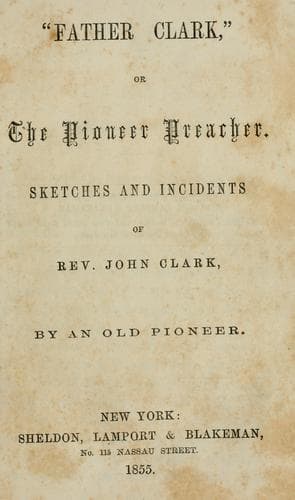
"Father Clark," or The Pioneer PreacherPeck, John Mason
History
"Father Clark," or The Pioneer Preacher
Peck, John Mason
Clark, John, 1758-1833; Methodist Episcopal Church -- Clergy
Surely there is no condition of servitude so galling to humanity, and
so directly a violation of human rights, and so subversive of rational
liberty, as the infamous press-gang in the British navy. We rejoice
that the just and humane sentiments of the age, have mitigated, though
not entirely removed, this odious form of despotism in the British
government. Through the operation of such oppression, Mr. Clark found
himself on board the Narcissus, of twenty guns, and most unwillingly
held in the service of George III. Read his own remarks on the subject.
“Now, I was more determined than ever to obtain my liberty. The
love of liberty is implanted in our very nature, and nothing can
supply the lack of it. We fared well on board the Narcissus; we had
the best of fresh meat when it could be obtained, besides butter,
cheese, plum-pudding, and a pint of Madeira wine for each day, but
all that could not supply the lack of rational liberty.
“The people of the slaveholding States ought to consider this
well; for the spirit of liberty is like a magazine full of powder.
If it takes fire, it will consume all within its reach, and the
danger increases daily. Many slaveholders sincerely conclude that
if they work their slaves moderately, clothe and feed them well,
the slaves ought to be contented, but Scripture, sound philosophy,
and experience--yes, my own experience--prove such arguments to be
sophistry. For although I fared on board the Narcissus as well as I
could reasonably desire, yet I was more discontented than ever. So
I found the old saying verified,--”
‘Feed me with ambrosia;
Wash it down with Nectar;
And what will it avail, if liberty be wanting.’
My desires for liberty and peace were so great, that death or
liberty was the constant language of my heart.”
About this time the British evacuated Savannah, and the Narcissus was
appointed a convoy to the transports that moved the refugees from that
city to St. Augustine. After performing this duty, the ship returned
and lay off Charleston again. Orders were issued to sail to New York,
and the night previous Clark and his mess-mates were employed in making
preparations for the voyage.
Public-domain text, read in full here on John Shaqi.
Reviews
Reviews
No reviews yet
Be the first to share your thoughts on this work.
Join the Discussion
Join the discussion
Sign in to leave a comment or review.
Sign InorCreate an account