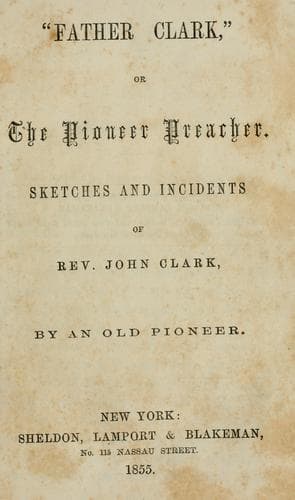
"Father Clark," or The Pioneer PreacherPeck, John Mason
History
"Father Clark," or The Pioneer Preacher
Peck, John Mason
Clark, John, 1758-1833; Methodist Episcopal Church -- Clergy
“The next thing that occupied my mind, was, how I would get to
Charleston, and what would I do there? I thought that with an old,
greasy and torn shirt, and a pair of trowsers as my only covering,
every one would take me for an idiot, or at least a worthless
vagabond. Could I have seen then as I now see, the hand of HIM who
makes sparrows, ravens, lions and other creatures objects of his
care; and that all his dispensations towards the children of men
are tokens of his paternal love, and means to instruct us;--that
without HIM we can do nothing;--if I had then seen these things as
I now do, I might have enjoyed peace with God, and been delivered
from all tormenting fear. But I was blinded by unbelief or I should
have known that what I had experienced the night before of the
goodness of God in my preservation would have inspired me with hope
for the future.”
He soon found a negro hut where he obtained food, and was told he could
get a passage to Charleston in a fishing boat. All this time Mr. Clark
knew nothing of the fate of his four comrades, who he was confident had
followed him, and who, he supposed, were in the ocean, or in nautical
language had “gone to Davy Jones’ locker.” He was taken in a fishing
boat across the wide river, and landed at the upper wharf, which he
regarded as a providential favor, for it gave him opportunity to keep
out of the way of the officers of the navy, and find amongst the common
sailors some old shipmate who might aid him in his necessities. He
found sailors, in great numbers, at every wharf, and there were many
ships taking in lading for British ports, expecting the war would soon
close. The great men of France, England, and the United States, were
then arranging terms of peace.
Mr. Clark continued his tour along the wharves until he almost
despaired of seeing any one who would befriend him. When almost at
his wits’ end, he espied three men putting tobacco into the hold of a
vessel, and to his astonishment and joy he knew them; for many months
before, he and his mess-mate John Scott had showed them what they
thought was a great favor. It is a peculiar trait of sailors to be
grateful, and never forget an act of kindness. But let the interview be
in his own language.
“I made towards them with quick steps, and a gladsome heart. I
found they were gentlemen indeed, though at first they did not seem
to know me. Their disinterested generosity exceeded any thing of
the kind I ever met with before. They clothed me from head to foot,
and gave me refreshment.[10] I then went into the hold, to assist
the second mate to stow away tobacco. I was not long engaged in
that business before I heard the voice of John Scott on deck--my
mess-mate, who I supposed was drowned. I concealed myself as
long as I could, while listening to his conversation; for he was
narrating the tragical story of the death of John Duncan and myself
to the captain.”
Public-domain text, read in full here on John Shaqi.
Reviews
Reviews
No reviews yet
Be the first to share your thoughts on this work.
Join the Discussion
Join the discussion
Sign in to leave a comment or review.
Sign InorCreate an account