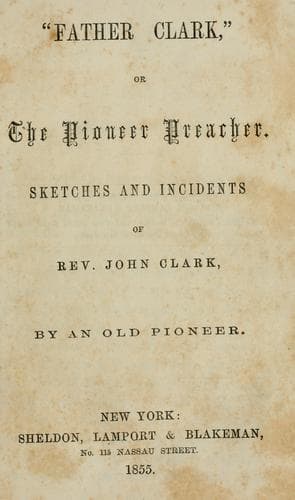
"Father Clark," or The Pioneer PreacherPeck, John Mason
History
"Father Clark," or The Pioneer Preacher
Peck, John Mason
Clark, John, 1758-1833; Methodist Episcopal Church -- Clergy
John Clark told him some thing of the history of his own life, how he
left the man-of-war and swam ashore, and how God mercifully preserved
his life in that perilous adventure. But when he told him how the Lord
brought him to see his wretched state as a sinner, and the wonderful
deliverance and joys of pardoning mercy in the interior of South
Carolina, and the new life he since lived;--all was so strange and
wonderful,--so unlike any thing he had heard before, and with all so
touching, that the tears rolled down the weather-beaten cheeks of
this tar; he sobbed aloud, and before he was aware of the scene he
was enacting, John Clark was on his knees beside his hammock, praying
in an audible, but low, musical voice for his salvation. No wonder
the sin-struck sailor thought John could pray better than the parsons
could with a book. True, he knew very little about parsons, for he had
followed the sea more than twenty years, and during that time had seen
“divine service” performed on land not half a dozen times. Sometimes
he heard the burial service read by a captain over the mortal remains
of some shipmate, who had been sent to “Davy Jones’ Locker,” over the
ship’s side.
From the time Mr. Halyard disclosed the character of John Clark to
the crew, he was treated with particular respect. Wild and wicked,
and as little disposed to knock off drinking and swearing, and put on
religion, all respected their shipmate John Clark. The officers found
out the “cut of his jib,” and treated him accordingly. Sailors find out
the peculiar traits of human nature quite as soon as any class. Had
Clark put on a sour face and assumed the airs of a religious man; had
he been unsocial and moody, and reproved them in a harsh and unkind
tone of voice, and in presence of others for their drinking, swearing
and frolicking habits, and taken pains to appear peculiarly righteous,
he would have seen trouble. They would have regarded him a graceless
hypocrite, and treated him with contempt and persecution. He gave them
no direct reproofs, and yet his manners and intercourse, courteous,
kind and winning, impressed their consciences more than a hundred moral
lectures would have done. They feared him, respected him and even loved
him.
Public-domain text, read in full here on John Shaqi.
Reviews
Reviews
No reviews yet
Be the first to share your thoughts on this work.
Join the Discussion
Join the discussion
Sign in to leave a comment or review.
Sign InorCreate an account