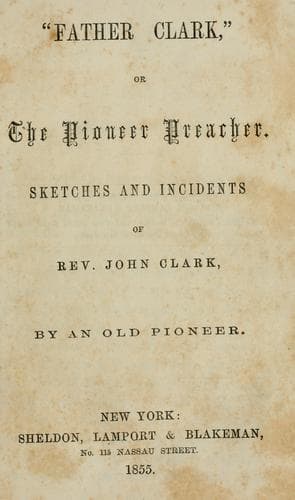
"Father Clark," or The Pioneer Preacher — John Shaqi
"Father Clark," or The Pioneer PreacherPeck, John Mason
History
"Father Clark," or The Pioneer Preacher
Peck, John Mason
Clark, John, 1758-1833; Methodist Episcopal Church -- Clergy
It became a fixed principle in the mind of Mr. Clark, at that early
period of his religious history to follow as Providence led; or,
which was the same thing to him, after a season of prayer for divine
direction, to follow such impressions of his own mind as appeared to
spring from a truthful and right source. Neither he, nor his companion
knew any chapel in London, or where to go;--but they walked on in a
friendly manner. Mr. Halyard asked questions how they were to conduct
themselves in church, and Mr. Clark described how the meetings were
managed in Georgia.
They had passed through several streets, when Mr. Clark saw a man
walking in the same direction, and ventured to inquire if he could
direct them to some chapel where the gospel was preached. “And it’s
being afther the gospel ye would be axing? Well, it’s mesel’ that
answer ye, for I’m a going there mesel’--’Tis to the Foundry ye’d
like to go?” Clark replied they were strangers in London, just from
ship-board, and wished to find some church where they could hear the
gospel. The honest Hibernian with whom they had come in contact, was
a zealous Methodist, then on his way to the “Foundry,” in Moorfields,
where the celebrated John Wesley established his regular meetings in
1739. This venerable patriarch of Methodism was still there, and
though fourscore years old, preached on the occasion of the sailors’
visit. Mr. Clark had heard of the achievements of Mr. Wesley, from the
preachers in Georgia, and it had been among his warmest aspirations to
see and hear this distinguished divine before his return to America.
It was a singular providence that guided him to the Foundry chapel the
first Sabbath he spent in London. The scene was almost overpowering,
and he listened with rapt attention and drank in every word the
preacher uttered.
Halyard wept profusely, though on board ship, and before his illness,
and Clark’s conversation, he had been singularly hard-hearted. No
distress could bring a tear from his eyes.
The other sailors behaved with decorum. The scene was new to all. None
before, except Mr. Clark, had ever known a “parson,” as they called all
ministers, pray without a book, or preach anything but a written or a
printed discourse. Whether any lasting impressions were made on their
companions is not known; but Halyard was an altered man, and one of the
“first fruits” of John Clark’s labors.
They spent the day at the Foundry; some of the generous-hearted,
christian brethren shared with them their lunch, and invited them to
attend class-meeting in the afternoon. The next week they obtained
their discharge from the ship, and Thomas Halyard went into the country
to find some distant relatives, and John Clark entered a coasting
vessel and sailed along the coast of England and Scotland, and up the
Moray Firth to Inverness, on his way to his native parish.
Public-domain text, read in full here on John Shaqi.
Reviews
Reviews
No reviews yet
Be the first to share your thoughts on this work.
Join the Discussion
Join the discussion
Sign in to leave a comment or review.
Sign InorCreate an account