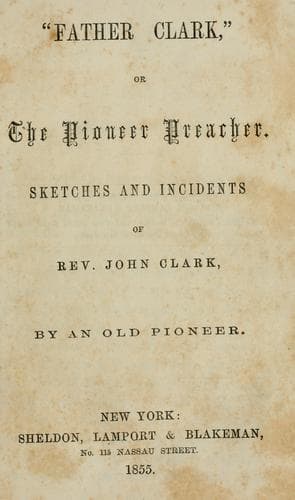
"Father Clark," or The Pioneer PreacherPeck, John Mason
History
"Father Clark," or The Pioneer Preacher
Peck, John Mason
Clark, John, 1758-1833; Methodist Episcopal Church -- Clergy
The schooner was safely moored at one of the docks in the harbor of
Inverness, and Mr. Clark, having obtained his discharge, and bid the
kind officers and crew a friendly farewell, proceeded up the city
towards his native parish. A familiar name on the sign of a shop-keeper
caught his eye, and he stepped within, and instantly recognized an old
acquaintance. Mr. Clark in youth, as in old age, was of very light
complexion, blue eyes, and light-colored hair, of moderate height,
and light, slender make. The man who stood before the shop-keeper,
was sun-burnt, swarthy, robust, and dressed in sailor trim. He could
perceive some lineaments in his countenance which seemed familiar,
but could not recollect when, or where, if ever, he had seen the
person that now stood before him, while he leaned over the counter.
Soon as Clark gave his name and parentage, both hands were seized with
a friendly grasp, and a shower of welcomes was poured out in genuine
Gælic; for though Mr. Mackenzie spoke English like a native, he never
failed to resort to his Highland tongue, when moved by strong emotions.
Upon inquiry Mr. Clark for the first time realized he was an orphan.
_His mother was dead!_ The generous Highlander had the tact to
understand that under the pressure of such intelligence, his guest
would do best alone. Again he bade him welcome in plain English, and
insisted his house should be his home while he remained in Inverness;
at least he must not leave that night;--introduced him into a neat
parlor, and, pleading special business for absence, left him to his own
thoughts. This retirement exactly suited the feelings of Mr. Clark. He
pondered over the parting scene with his father and mother; counted
up nine years and some months since that time; recollected his mother
was more than three-score and ten years old; that she was a true child
of God, and died with a full hope of eternal life, and that the only
trouble she felt was about the uncertain fate of her youngest son
John. He learned also, from the Highlander, that his father ceased
his intemperate habits soon after their parting, and appeared to have
become a true penitent, and died in peace. A married sister who lived
near Inverness had died in child-bed shortly after his mother.
With a chastened spirit of submission he fell on his knees, and
with mingled feelings of thankfulness and grief, he found relief in
committing himself and his surviving relatives to God. Before he left
Scotland he heard of the untimely death of his brother Daniel in the
island of Jamaica.
Public-domain text, read in full here on John Shaqi.
Reviews
Reviews
No reviews yet
Be the first to share your thoughts on this work.
Join the Discussion
Join the discussion
Sign in to leave a comment or review.
Sign InorCreate an account