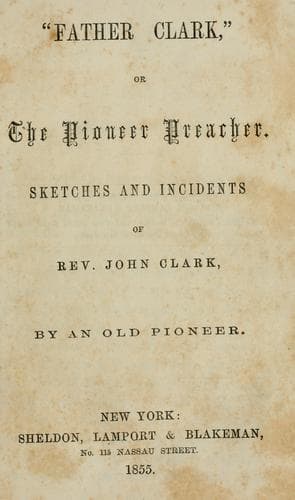
"Father Clark," or The Pioneer PreacherPeck, John Mason
History
"Father Clark," or The Pioneer Preacher
Peck, John Mason
Clark, John, 1758-1833; Methodist Episcopal Church -- Clergy
Though he had not mentioned marriage to the young woman, much less
gained her affections and raised hopes, by solemn protestations and
promises to be now blasted, he had that nice sense of honor; or shall
we say Christian duty, to make her a final visit and avow his feelings,
and the conclusion to which he had arrived on a point of duty to God
and the church. He expressed the hope she would ever regard him with
Christian friendship. His age at this period must have been about
thirty-five years, and no one after ever heard him express a desire,
or a regret concerning the connubial relation.
His anxieties about leaving the Methodist Episcopal church, and his
feelings relative to slavery, were at a culminating point in 1795. His
views of slaveholding were not discordant with the expressions of the
church he served. This subject had been agitated in the Conferences
for several years. In the minutes for 1784, we find this rule, in the
forms of question and answer, and it remained in force during the whole
period of Mr. Clark’s connection with the Conference:
“_Ques. 12. What shall we do with our friends that buy and sell
slaves?_
“_Ans._ If they buy with no other design than to hold them as
slaves, and have been previously warned, they shall be expelled,
and permitted to sell on no consideration.”[24]
In answer to his oft repeated prayer for divine direction as to
the field of his future labors, he received the impression, and it
became a conviction of duty, that he must travel in a north-western
direction. Tennessee and Kentucky were in that direction, and the
Illinois country, and the Spanish province of Upper Louisiana far
in the distance beyond; but he felt a calm confidence in Divine
Providence, and that the specific field of usefulness would be pointed
out in due season. All these questions were agitated and settled in his
own judgment and conscience, before he made known his decision to his
brethren.
The next Annual Conference would be in Charleston, January 1st, 1796,
but it was not necessary for him to be present. His withdrawal could
be tendered by some of the brethren. He attended the last Quarterly
Conference in the district, where he gave notice of his intention
of a withdrawal from the government and discipline of the Methodist
Episcopal Church. This he had a right to do without any forfeiture or
implication of his ministerial character. His brethren respected his
feelings and scruples, and would give a fair representation of his case
to the Annual Conference.
Public-domain text, read in full here on John Shaqi.
Reviews
Reviews
No reviews yet
Be the first to share your thoughts on this work.
Join the Discussion
Join the discussion
Sign in to leave a comment or review.
Sign InorCreate an account