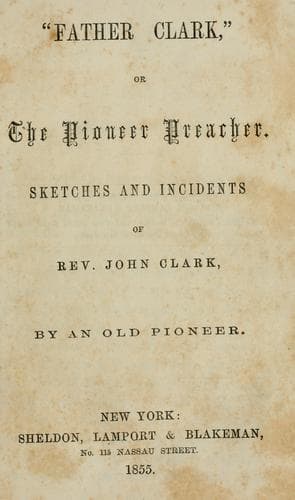
"Father Clark," or The Pioneer PreacherPeck, John Mason
History
"Father Clark," or The Pioneer Preacher
Peck, John Mason
Clark, John, 1758-1833; Methodist Episcopal Church -- Clergy
More than two years before this period, Preacher Clark, and two other
Methodist ministers, held a meeting for several days in a frontier
settlement, some twelve or fifteen miles from the ferry, and Mrs.
Patsey Wells was there. Mr. Wells had emigrated from Pittssylvania
county, Virginia, to Georgia, about eight or nine years previous. He
was not a professor of religion, but accustomed to hear the Baptists
in his native State. His wife’s father and mother were Baptists, and
she had been in the habit of attending their meetings, and at times was
under serious impressions. She thought she must wait the Lord’s time,
when, if she was to be converted, she would be; at least she understood
the matter in this way from what she heard the preachers say. In the
new region of Georgia, where they settled, there was no preaching,
or preacher of any kind. Her husband got hold of a valuable tract of
land lying along the Savannah river, on the south, or Georgia side,
at a convenient crossing-place, where he established a ferry. In the
course of a few years it became a thoroughfare on one of the principal
roads leading from the settlements on the Upper Oconee and Broad river,
across the upper part of South Carolina towards Virginia.
Mrs. Wells felt unhappy that her children were growing up without any
religious instruction, and she could hear no one preach. But she had
the care of a family to claim her attention, and withal became quite
worldly in spirit, as their landed property rose in value, and the
comforts of life increased. She was industrious, tidy, and kept on well
after a worldly sort, but still felt at times unhappy, as if there was
some great want unsupplied.
Mr. Wells was a good-natured, hospitable man, seldom got in debt, and
then got out as soon as possible. He was reasonably industrious and
with four stalwart sons, who were from twelve to eighteen years of age,
he had opened a large farm and made some tobacco for the Charleston
market. The reason he gave why he bought no negroes was, “he thought
them more plague than profit,” and he was determined his sons should
learn to work, and get their living as he had done, by hard labor.
He really thought he was a good man, though he never served the Lord,
nor thought of the high and responsible relation he sustained to his
Creator and Redeemer, and made no provision for another world. True
he loved a big dram, and the habit increased on him, but he only got
tipsy, and behaved very foolish when he attended courts, elections, and
horse-races; and mortified his wife Patsey by his silly behavior when
he came home late at night. He was good-natured when drunk, boasted
of his wife, children, and property, and never abused Patsey or the
children; and would laugh, and tell jocular stories about himself, when
he was sober.
Public-domain text, read in full here on John Shaqi.
Reviews
Reviews
No reviews yet
Be the first to share your thoughts on this work.
Elsewhere in the archive
Join the Discussion
Join the discussion
Sign in to leave a comment or review.
Sign InorCreate an account