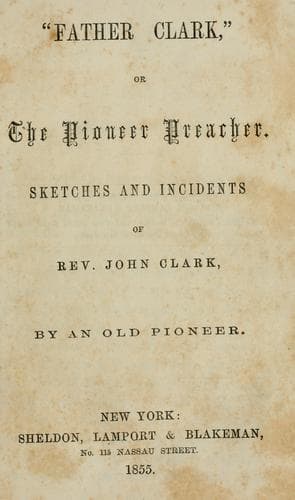
"Father Clark," or The Pioneer PreacherPeck, John Mason
History
"Father Clark," or The Pioneer Preacher
Peck, John Mason
Clark, John, 1758-1833; Methodist Episcopal Church -- Clergy
His wife Patsey, as he called her when talking about her to others,
heard of the Methodist meeting and felt very much like going. She had
heard Methodist preachers in Virginia, but did not like their ways,
and would have preferred to hear the Baptists; but none came into that
settlement. One of her old Virginia female acquaintances lived at the
place of the meeting, and she had intended for a long time to make her
a visit; and now it would be economical in time and expense to gain two
objects in one journey. So she left the “old man” and younger boys to
tend ferry and keep house with the two little girls; and she, and her
eldest son, went each on horseback to the meeting.
It was a powerful time on the frontiers; there was a shaking among the
dry bones; and many a stout-hearted sinner fell as if slain before the
Lord. There were three preachers present, each with gifts differing
from those of his brethren. The first we shall describe, was considered
as a sort of Boanerges among his brethren; at least so far as lungs
and voice were concerned. And he used many “big words,” quite beyond
the comprehension of plain, illiterate people. Some supposed him to be
a great preacher, and very learned, because they could not understand
him. The second preacher was what the people called “a powerful
exhorter.” He could not work in the lead to any advantage, but he could
follow a clear-headed preacher, and enforce the things said on the
consciences of the people by persuasive language and apt illustrations
with great effect. Mr. Clark after all did most of the real preaching,
and every one on the ground heard him with fixed attention.
The meeting was held in the shade of the forest, where a “stand” had
been prepared for the purpose. This was an elevated platform of split
slabs, and a book board, breast high in front of the preacher, on
which he might lean. Seats were made of the halves of small timbers,
the ends of which were placed on logs, and covered over a space of
ground large enough to accommodate several hundred hearers. In front
of the stand was an open space, with low seats around, and called the
altar, where the “mourners,” or persons who were seriously impressed,
were invited. At a late hour they separated and went to the houses of
the people who lived within a convenient distance for refreshment and
lodging. Prayer meetings were held at the houses at night, until late
bed-time. Some families that came from a distance with wagons, brought
provisions and encamped on the ground. Others, as did Mrs. Wells and
her son, were accommodated by the hospitality of the people, and
invitations were given publicly each day, if any strangers had arrived,
they would find a welcome. This was not a regular camp-meeting, for
those religious gatherings had not been instituted.
Public-domain text, read in full here on John Shaqi.
Reviews
Reviews
No reviews yet
Be the first to share your thoughts on this work.
Elsewhere in the archive
Join the Discussion
Join the discussion
Sign in to leave a comment or review.
Sign InorCreate an account