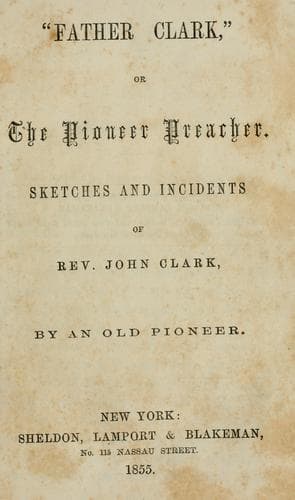
"Father Clark," or The Pioneer PreacherPeck, John Mason
History
"Father Clark," or The Pioneer Preacher
Peck, John Mason
Clark, John, 1758-1833; Methodist Episcopal Church -- Clergy
And there was another duty to perform which no itinerant, or faithful
pastor, will neglect. Religious meditation, and especially prayer
in the hearing of others, was a new business to Mr. Wells, and it
required just such a man as Father Clark to encourage, instruct and
lead him into the practice of household religion. Though his speech was
somewhat incoherent, and a tremor shook his brawny limbs, in making
the first attempt in presence of the preacher, his wife and children;
he had decision enough to go forward, and soon acquired a gift that
was profitable in the society and class-meetings. And now there was
another serious difficulty. He had no Bible in his house; only a torn
and shattered Testament, which his wife had read over and over, on
the dreary Sabbaths she had passed with her family. Her husband had
promised on two occasions, when he visited Charleston and sold his
tobacco, to buy one. But on one journey he had made inquiry at several
stores and found none; the other time “getting a little overtaken,” as
he called it, he had forgotten the business, though he did not fail
to bring his wife a new calico dress, and several other luxuries she
had not requested. The idea of Bible Societies, and special efforts to
supply the destitute with the Word of God, had entered into the mind of
no one. Nor could such books be found for sale in any of the interior
settlements of the South or West.
Father Clark had a neat pocket Bible, which he obtained in London,
and which was his daily companion. He was now in a strait betwixt the
conflicting claims of duty. Generosity and sympathy spoke loudly to
his heart to give this family his Bible. Conscience and reason seemed
to say, “You cannot spare this book. How can a preacher do without
a Bible?” After a season of prayer on the subject, faith turned the
scale, “Leave the Bible, and trust in the Lord for another;” and so it
was decided, and he never regretted it.
The parting scene was affecting. Mr. Wells and his wife both wept like
children, and begged him not to forget them in his prayers, and if
he ever came that way again to make their house his home. The whole
family walked with him to the river bank, and Mr. Wells and his two
eldest sons worked the ferry-boat over the river. As they turned into
a slight bend in the river, they could see mother Wells still sitting
on the bank, with her handkerchief to her eyes, deeply affected that
she should see her preacher’s face, and hear his voice no more; yet,
devoutly thankful that the Lord had sent him that way as the instrument
of salvation to her house.
Public-domain text, read in full here on John Shaqi.
Reviews
Reviews
No reviews yet
Be the first to share your thoughts on this work.
Elsewhere in the archive
Join the Discussion
Join the discussion
Sign in to leave a comment or review.
Sign InorCreate an account