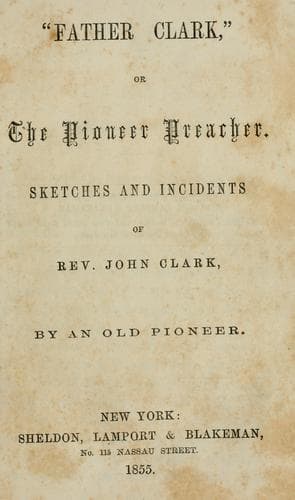
"Father Clark," or The Pioneer PreacherPeck, John Mason
History
"Father Clark," or The Pioneer Preacher
Peck, John Mason
Clark, John, 1758-1833; Methodist Episcopal Church -- Clergy
The boat was tied to the shore, and the old man and his two sons walked
with the preacher through the low bottom-land that lined the bank of
the Savannah river, to the bluffs and up-lands of South Carolina. As
they were about to part, the preacher kneeled down and prayed with
them, and especially mentioned the young lads, that they might be
like young Timothy, and serve the Lord from their youth. Mr. Clark
was now seen slowly but cheerfully ascending the sloping hills, that
led towards Greenville district, while in silence the father and sons
returned to their home.
Leaving father Clark to pursue his journey towards the mountain
range in the north-west, we will continue a while on the banks of the
Savannah, to learn a little of the future history of the Wells family.
The rule of the Saviour, to judge of religious excitements and
conversions, is, “By their _fruits_ shall ye know them.” Our
metaphysical and philosophical friends, with the class of
cold-blooded, grave divines, who measure the character of others by
their own passionless natures; with the sentimental ladies who are
dreadfully shocked at religious ebullitions, may be assured that the
excitable Mrs. Wells, and her more sluggish husband, never “fell from
grace,” as our Methodist friends denominate the result of spurious
conversions. It is true they left the Methodist society, and were
baptized into the fellowship of a Baptist church, but this was in
accordance with their original predilections and previous training.
During the period of Mr. Clark’s sojourn in Georgia, Baptist churches
and preachers were more numerous than Methodists. In the region south
and east of Augusta, they were by far the most numerous class of
Christians. In 1792, there were about fifty-seven Baptist churches,
fifty-eight ordained preachers, twenty-five candidates, and about 2,400
communicants in Georgia. The Georgia Association had been constituted
in 1784, and in 1792 included about twenty-five churches. The Hepzibah
Association was organized in 1794, and the churches extended along the
waters of the Ogeechee and Oconee rivers. The ministers who itinerated
in upper settlements, on Oconee and Broad rivers, after Mr. Clark left
the country, were Mr. John Cleveland, who crossed the Savannah river
from South Carolina, D. Thornton, William Davis, Thomas Johnson, and
Thomas Gilbert. Mr. Cleveland became acquainted with the Wells family
by crossing their ferry, and they liked his style of preaching and that
of his brethren, and being taught the way of the Lord more perfectly,
with others, were baptized, and a church was raised up near their
residence.
CHAPTER VIII.
Mountain Range.--Manners of an Itinerant.--Preaching in a
Tavern-house.--How to avoid Insults.--Hospitality.--Reaches
Crab-Orchard.--Preachers in Kentucky.--Baptists; “Regulars” and
“Separatists.”--Principles of Doctrine.--School-Teaching.--
Master O’Cafferty and His Qualities.
Public-domain text, read in full here on John Shaqi.
Reviews
Reviews
No reviews yet
Be the first to share your thoughts on this work.
Elsewhere in the archive
Join the Discussion
Join the discussion
Sign in to leave a comment or review.
Sign InorCreate an account