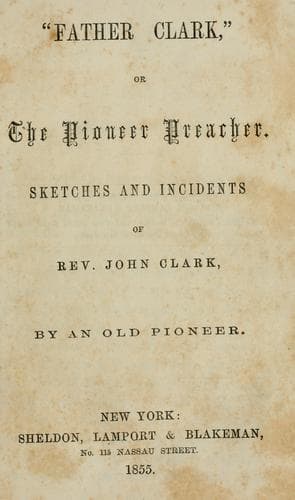
"Father Clark," or The Pioneer PreacherPeck, John Mason
History
"Father Clark," or The Pioneer Preacher
Peck, John Mason
Clark, John, 1758-1833; Methodist Episcopal Church -- Clergy
Down the mountain range, towards Crab-Orchard, the country was thinly
settled. Every eight or ten miles was a cluster of log-cabins, with
stabling of the same materials, a rack to hitch horses at in front, and
occasionally a rudely daubed sign on a post, that on close inspection
might indicate that “_private entertainment_” could be had there.
No public houses existed in that region, unless in a town or county
seat, where lawyers and clients, judges and jurymen, could purchase
intoxicating liquors to wash down their corn-bread and bacon on
court days. Every farmer through the country, who lived on a great
road, and had a supply of “corn and fodder” for horses, “and chicken
fixin’s,” and “corn dodgers,” with comfortable beds for travelers,
kept “private entertainment.” No one thought of getting a license and
selling intoxicating drinks. The bottle or jug of whiskey was always
set on the table at such houses of entertainment, with a bowl of sugar,
and a pitcher of water fresh from the spring, and “help yourselves,
strangers,” was the courteous invitation. Whether the traveler drank
more or less, or none at all, made not the least difference in his
bill. Fifty cents for horse-keeping, supper, and lodging, was the
uniform price for nearly half a century, at these country houses of
entertainment throughout this valley. And if any one had charged Father
Clark, a quarter or three bits[30] was ample compensation.
It was early in April when our Itinerant reached the vicinity of
Crab-Orchard, in Lincoln County. Hearing there was an appointment for
preaching in the neighborhood, he went with the family with whom he
had put up. The preacher was a plain frontier-looking man, dressed in
the costume of the country; a hunting-shirt of dressed deer-skins,
and trowsers of cotton and wool mixed, of very coarse texture, colored
brown with the bark of a species of the white walnut tree.[31] The
house where the people assembled was a double log cabin, rough hewn,
and when all had gathered, it contained about seventy-five or eighty
persons. The name of the preacher was Jolliff; and he preached the
Gospel to his neighbors and the people generally, as opportunity
offered, without any thought about compensation in this life. He was
a plain, unlearned preacher, and enforced such truth as he understood
on the minds of his hearers. He had been, and perhaps was still a
Methodist preacher of the local order, but he afterwards joined a class
of Baptists called _Separates_ in Kentucky.
Public-domain text, read in full here on John Shaqi.
Reviews
Reviews
No reviews yet
Be the first to share your thoughts on this work.
Elsewhere in the archive
Join the Discussion
Join the discussion
Sign in to leave a comment or review.
Sign InorCreate an account