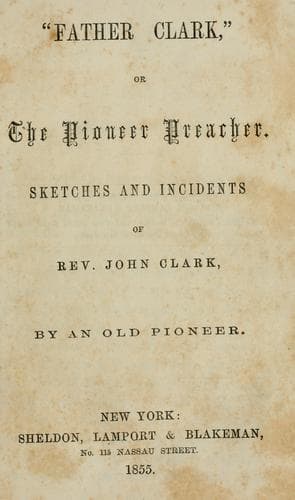
"Father Clark," or The Pioneer PreacherPeck, John Mason
History
"Father Clark," or The Pioneer Preacher
Peck, John Mason
Clark, John, 1758-1833; Methodist Episcopal Church -- Clergy
Mr. Clark’s dress we have already described, but it was in a style
somewhat in advance of the good people in Kentucky, who lived many
hundred miles distant from any market, and were compelled to live
in a plain, rough way. Mr. Jolliff fell into conversation with the
stranger, while the people were gathering, found out his business in
the country, and insisted he should preach. Apologies and excuses are
useless on such occasions for those ministers who keep their minds in
habitual preparation to say something to the people on any sudden call,
and Mr. Clark, though a modest man, who never put himself forward,
consented. The people listened with attention, and spoke of him as “a
right smart preacher.” Some doubted what others affirmed, that he was
a learned man, for he was so plain and simple in his language, and his
illustrations were from things so common, that they understood every
word.
Mr. Jolliff, who lived several miles from the place of meeting, was so
much pleased with the discourse, that he persuaded Mr. Clark to attend
the meeting in his neighborhood on the following Saturday and Sabbath,
and to come to his house on Friday evening.
There were a number of preachers in Lincoln and the adjacent counties,
all Baptists, though somewhat divided on certain points of doctrine,
and not altogether friendly in ministerial intercourse. Each possessed
his share of the imperfections of human character; each was more or
less selfish; petty rivalries prevailed, and small differences were
magnified, as each party looked at the other through the medium of
prejudice. In a word, the pioneer preachers of Kentucky, were very
much like the ministers of the Gospel in every age, nation, and
country; no better, no worse; only a little more frank, and even blunt
in their personal intercourse, and did not conceal their thoughts
and emotions with the same ingenuity and tact as has been done in
some places. Hence, if there were petty jealousies, rivalries, and
surmisings, (all of which traits are wrong and unchristian every
where,) they let their passions be seen, and the want of union and
mutual coöperation was the natural result.
There were two principal divisions amongst Baptists in Kentucky, which
were brought with them from Virginia and the Carolinas. The parties
were called “_Regular_,” and “_Separate_.” These parties originated
more than forty years before the period of our history.
Public-domain text, read in full here on John Shaqi.
Reviews
Reviews
No reviews yet
Be the first to share your thoughts on this work.
Elsewhere in the archive
Join the Discussion
Join the discussion
Sign in to leave a comment or review.
Sign InorCreate an account