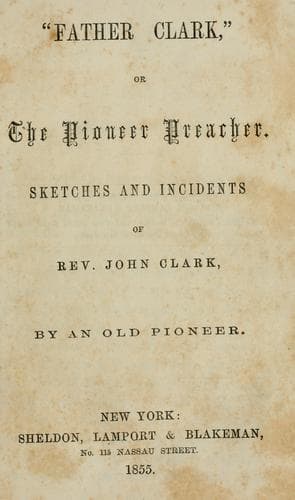
"Father Clark," or The Pioneer PreacherPeck, John Mason
History
"Father Clark," or The Pioneer Preacher
Peck, John Mason
Clark, John, 1758-1833; Methodist Episcopal Church -- Clergy
in the direction of “Holy Mother Church.” In this particular item his
services were gratuitous; but he was unsuccessful in all he undertook,
whether publicly or privately. He lacked every qualification for a
successful emissary in the charitable designs of the good father. Mr.
O’Cafferty made slow progress in retailing science and literature
during the six months he engaged to teach school on Flat Creek, and
such was the turmoil among his subjects, and so much whiskey did he
punish weekly, that he found it economical to accept the compromise
proposed by his employers and be off, on half pay for the last term.
CHAPTER IX.
Schoolmaster Equity in 1796.--New Customs introduced.--Mr. Birch
Discarded.--Enrolment.--Books Used.--New ones Procured.--
Astonishing Effects.--Colloquy with Uncle Jesse.--The New
School-House.--A Christmas Frolic.--Shocking Affair by the
Irish Master.--A Political Convention.--Young Democracy.--
A Stump Speech.--New Customs.--A True Missionary.--Trouble
about Money.--Mr. Clark leaves Kentucky.
The relation of the teacher and the pupils heretofore in most instances
had been that of belligerents. It was his prerogative to rule and
compel obedience, and hence “fighting,” as the customary whippings were
called, was the order of the day. Those pupils who were from fifteen
to twenty years of age, thought themselves young men, and their proud
spirits could be easily aroused to a state of rebellion. They descended
from a hardy race, and had learned the tactics of warfare on the
frontiers, where their fathers and mothers had to contend with untamed
savages, and it would have been a dangerous business for even a brawny
Irishman to flog such spirits into submission with a full supply of
bone, sinew and muscle. Hence the boys from eight to fourteen, who had
no brothers and cousins among these stout youngsters, had to bear their
own share of flaggellation, and also the amount that in equity belonged
to their older neighbors. The school house had remained vacant for six
or eight months previous to Mr. Clark’s entrance, and the youngsters
gathered around him as we have narrated.
Instead of the expected order, in a surly voice, and corrupt dialect
that was any thing else than the English language, Mr. Clark opened
school by a friendly conversation with each scholar; beginning with
the eldest. Divers questions were asked, in a pleasant, musical tone
of voice, as “How far have you made progress in studies?” “What
branches do you wish to learn?” etc. He addressed the young men as
though they were gentlemen, and as if he was desirous of consulting
their interests, and do the best to serve them. Instead of their usual
boisterous manner of reply, their voices were subdued, and they felt
what they never before realized, sentiments of reverence and respect to
a schoolmaster.
Public-domain text, read in full here on John Shaqi.
Reviews
Reviews
No reviews yet
Be the first to share your thoughts on this work.
Elsewhere in the archive
Join the Discussion
Join the discussion
Sign in to leave a comment or review.
Sign InorCreate an account