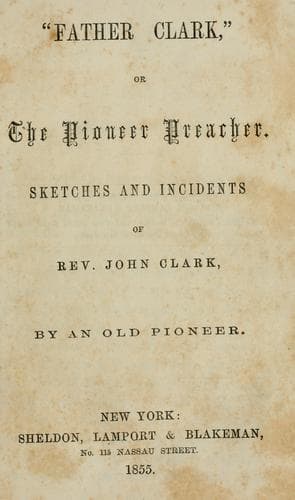
"Father Clark," or The Pioneer PreacherPeck, John Mason
History
"Father Clark," or The Pioneer Preacher
Peck, John Mason
Clark, John, 1758-1833; Methodist Episcopal Church -- Clergy
Mr. Clark attended the appointment on Saturday and Sabbath with Mr.
Jolliff, and preached with his accustomed fervor and ability. The
people who heard him were much interested, and urged him to stay
amongst them. He found the settlements very deficient in schools; young
men and women could not read, and very few books could be found. In
many instances the teachers were incompetent, and in some instances
too immoral to be trusted with the training of youth. He saw around
him a wide field of usefulness. There were occasional revivals, but
in general a religious dearth prevailed over the State. Revivals had
existed to a greater extent in past years, but a general declension
had followed, and a low standard of morals and religion existed. The
Indian war on the north-western territory kept the country in agitation
until after Wayne’s victory in 1794, and the treaty of Greenville the
following year. The tide of immigration was now setting strong from
the Atlantic States to Kentucky, while a class of its population were
on the move to the territory north-west of the Ohio, and even to the
province of Upper Louisiana. Infidelity, combined with liberalism,
came in like a flood and threatened to sweep away every vestige of
Christianity.
Under these circumstances, and on the solicitation of many worthy
citizens, Mr. Clark believed it to be his duty to teach school.
This would not prevent him from preaching the gospel, for he would
have Saturday and Sabbath in each week for that purpose. The people
furnished him a cabin, such an one as he had occupied in Georgia, for a
school house. In one particular he was singular. He drew up no article
of agreement, made no conditions about the number of scholars, and
exacted no pay; but left the whole arrangement about the terms of the
school with the people who patronized him; only requesting them to
furnish him with board and lodging at their houses, or log cabins, and
such articles of clothing as he might need. Some thought him slightly
deranged; others, from their habit of surmising evil of all strangers
whose notions differed from theirs, fancied he had some sinister design.
The school opened, and about twenty stout lads and lasses were there
the first day. Mr. Clark received each one with a pleasant, smiling
countenance, gave them his hand in friendly greeting as they approached
him, with a cheerful “good morning,” and appeared at once to be on
friendly terms. This conduct on the part of the schoolmaster, was,
to them, a new feature in discipline. They had been accustomed to be
greeted with a wand of hickory or hazel, (the genuine _birch_ not being
a growth of that region) and a stern, commanding voice. The predecessor
of Mr. Clark was a rough looking Irishman, with a red face, and of
violent passions. He was a disciple of Father Badin, the Roman Catholic
missionary at Bardstown, and sent to Lincoln county--
“To rear the tender thought,
And teach the young idea
How to shoot”
Public-domain text, read in full here on John Shaqi.
Reviews
Reviews
No reviews yet
Be the first to share your thoughts on this work.
Elsewhere in the archive
Join the Discussion
Join the discussion
Sign in to leave a comment or review.
Sign InorCreate an account