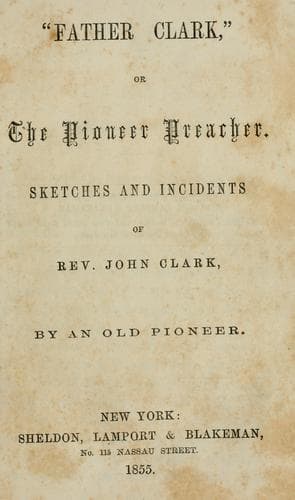
"Father Clark," or The Pioneer PreacherPeck, John Mason
History
"Father Clark," or The Pioneer Preacher
Peck, John Mason
Clark, John, 1758-1833; Methodist Episcopal Church -- Clergy
The next movement was to make inquiry about books; and here no small
difficulty and inconvenience appeared. Each pupil had brought such
an article for the reading lessons as first came to hand. One had
a mutilated copy of Dilworth’s “New Guide to the English Tongue;”
another showed a volume of old sermons; a third had the “Romance
of the Forest,” an old novel, and a specimen of the “yellow covered
literature” of a former age. A fourth, fifth, and sixth, could show
Testaments or pieces of Bibles, with the binding in tatters, and
the print dim, and paper brown, such as were gotten up for sale to
merchants in that day. Some came without books or any aid to learn the
art and mystery of spelling and reading. The Psalter that had descended
from some Virginia families whose ancestors belonged to the Colonial
English Church, was presented by three or four more. The marvellous
story of “Valentine and Orson,” answered for the whole stock of
literature for a family of three children. What was now to be done? Mr.
Clark neither scolded nor ridiculed his pupils for their deficiency in
books. He knew they were not to blame, and he surmised their parents
could not readily remedy the evil. There was not a book in the three
little retail stores in Lincoln County, for sale, and it was between
fifty and sixty miles to Lexington where purchases could be made. The
world-renowned Noah Webster had commenced the great work of providing
his young countrymen with the means of learning their mother tongue,
about thirteen years previous. His “_First Part of a Grammatical
Institute of the English Language_,” more popularly known as the
“American Spelling-Book,” was published for the first time in 1783, but
it had scarcely found its way into the wilderness of Kentucky. Father
Clark had obtained a copy in Charleston; he liked every thing American,
and Webster’s Spelling Book struck his fancy, above all others, from
which he would like
“To teach the young idea how to shoot.”
None had been seen in Lincoln County. Transylvania Seminary had been
in operation in Lexington, ten or twelve years, where some of the
higher branches of literature and science were taught, and many of the
young men who became distinguished in law, politics, and medicine, in
that commonwealth, received their education in that Seminary. After
Mr. Clark had left the State in 1798, a Grammar School was opened in
Lebanon, near the Royal Spring, in Fayette County, where the elements
of Latin, Greek, and the sciences, were taught by Messrs. Jones and
Worley.
The old books had to be used until Mr. Clark’s new method of teaching
became known, and one of the employers visited Lexington on business.
He returned with two dozen of Webster’s Spelling-Book, and more other
school-books than ever before reached Lincoln County at one time. It
was a real holiday for the boys and girls to look over these books.
Public-domain text, read in full here on John Shaqi.
Reviews
Reviews
No reviews yet
Be the first to share your thoughts on this work.
Elsewhere in the archive
Join the Discussion
Join the discussion
Sign in to leave a comment or review.
Sign InorCreate an account